Appearance
Self-intersection detection and resolution
What it does
Two TBPs that bracket the self-intersection problem:
surface%find_self_intersections(pairs, status)— detection. Returns the list of every facet pair(a, b)whose triangles cross, with the 3D segment endpoints of the intersection.surface%resolve_self_intersections(status)— resolution. Cleans the surface up by collapsing every self-crossing through a self-boolean union (boolean(self, self, BOOL_UNION)).
Real-world STL exports routinely have self-intersections. They slip through is_watertight() (the topological-edge test is satisfied even when triangles geometrically cross), so any downstream operation that assumes a clean solid — booleans, signed distance, voxelization for cut-cell — silently produces wrong answers. Detection is the first step; resolution is what you reach for when sanitize alone can't fix the input.
Pipeline (detection)
- Tree-vs-tree broad phase. Walk the AABB tree against itself, collecting every leaf-pair whose AABBs overlap. Reuses the existing
enumerate_childrendispatcher so SAH BVH and octree both share the traversal code. - Pool-aware adjacency filter. Two facets that share a vertex or edge are expected to "intersect" along that shared feature; we filter those out so only real geometric crossings remain. The adjacency check uses the vertex-pool ID equality, not just coordinate proximity.
- Möller tri-tri narrow phase (
facet%intersect_facet). For each surviving facet pair, test whether the two triangles actually cross transversally. Reports the segment endpoints when they do.
Pipeline (resolution)
resolve_self_intersections is a one-line wrapper over the boolean engine:
fortran
call self%boolean(other=self, op=BOOL_UNION, status=status)The §1.1 arrangement code treats self vs self symmetrically: every self-crossing becomes an arrangement segment, every input triangle gets retriangulated, the per-sub-triangle winding-number tagging keeps only the outer-manifold sub-triangles. Inherits §1.1's axis-aligned coplanar limitation.
API
Detection
fortran
call surface%find_self_intersections(pairs=pairs, status=status)
   type(intersection_pair_t), allocatable, intent(out) :: pairs(:)
   integer(I4P),                           intent(out), optional :: status
pairs is always allocated (zero-length if no intersections found). Each record carries:
pairs(i)%a,pairs(i)%b— facet IDs witha < b.pairs(i)%p,pairs(i)%q— segment endpoints in world coordinates.
Resolution
fortran
call surface%resolve_self_intersections(status=status)
   integer(I4P), intent(out), optional :: status  ! BOOL_STATUS_*
Mutates self in place. Output is self-intersection-free modulo the §1.1 coplanar limitation — perturb the input by ~1e-6 * bbox_diag along each axis if you suspect coplanar self-overlaps.
Example: detection
The dragon fixture in this repo is known dirty — it ships with ~759 real self-intersections and is the regression workhorse for §1.2:
fortran
program ex_find_self_intersections
use fossil
use penf,   only : I4P
implicit none

type(surface_stl_object)               :: dragon
type(intersection_pair_t), allocatable :: pairs(:)
integer(I4P)                           :: status

call dragon%load_from_file(file_name='src/tests/dragon.stl', guess_format=.true.)
call dragon%find_self_intersections(pairs=pairs, status=status)
print '(A,I0,A,I0)', 'dragon: ', dragon%get_facets_number(), &
      ' facets, ', size(pairs), ' self-intersection pairs'
endprogram ex_find_self_intersections
For a clean mesh (cube.stl, bunny.stl), the same call returns size(pairs) == 0 — the no-false-positive guarantee against the adjacency filter (every shared edge would otherwise register as a pseudo-intersection).
Example: resolution
fortran
program ex_resolve_self_intersections
use fossil
use penf,   only : I4P
implicit none

type(surface_stl_object)               :: dragon
type(intersection_pair_t), allocatable :: pairs(:)
integer(I4P)                           :: status

call dragon%load_from_file(file_name='src/tests/dragon.stl', guess_format=.true.)
call dragon%find_self_intersections(pairs=pairs, status=status)
print '(A,I0)', 'before: ', size(pairs)

call dragon%resolve_self_intersections(status=status)

call dragon%find_self_intersections(pairs=pairs, status=status)
print '(A,I0,A,I0)', 'after:  ', size(pairs), '  status=', status
endprogram ex_resolve_self_intersections
Visual reference
The dragon fixture (~6.6k facets):
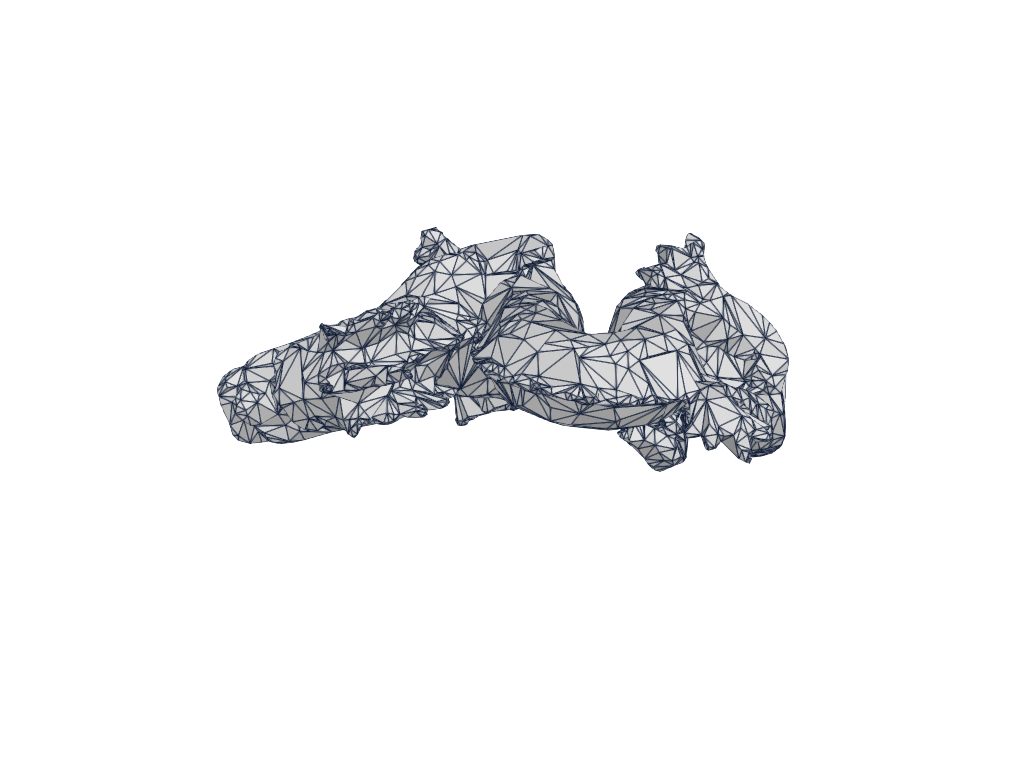
Visually the dragon looks fine; the self-intersections are interior geometric crossings invisible from outside. That's the whole point of find_self_intersections — these are the defects that escape eye inspection and that is_watertight() doesn't catch.
Known limitations
- Resolution inherits §1.1's coplanar limitation. Self- intersections that involve coplanar facet pairs (axis-aligned cases especially) may produce a
resolveoutput with the same silent-wrong-volume behaviour documented for the boolean. Workaround is the same: perturb by~1e-6 * bbox_diag. Most real-world dirty STL has generic-position self-intersections (random angles, no coplanar overlap) and the resolution works cleanly. resolve_self_intersectionsreturns the topology ofBOOL_UNIONapplied to the surface against itself. Interior cavities formed by self-intersections are dropped, not re-meshed — if the input had meaningful interior structure, it's gone after resolve.- Detection is
O(n_pairs)in the worst case, wheren_pairsis the number of overlapping leaf-pairs found in the broad phase. For the dragon fixture (~6.6k facets) this is ~10× faster than brute- forceO(n²)pair enumeration; for cleaner meshes the speedup is much larger because few leaves overlap at all.
See also
- booleans — the resolution path is a one-liner over the boolean engine; same coplanar limitation applies.
surface%sanitize— local defect repair (degenerate / duplicate facets, normal orientation). Run this beforefind_self_intersectionsto filter out intersection records that exist only because of degenerate-facet noise.- alpha wrapping — the heavyweight alternative for inputs too dirty for
resolveto handle (large holes, missing facets that aren't just self-intersection artifacts).
References
- Möller, A Fast Triangle-Triangle Intersection Test, Journal of Graphics Tools 2(2), 1997. The narrow-phase test.
- Zhou, Grinspun, Zorin & Jacobson, Mesh Arrangements for Solid Geometry, SIGGRAPH 2016. The reference algorithm for the §1.1 boolean that
resolve_self_intersectionsreuses. - libigl
igl::SelfIntersectMesh— the closest open-source reference; FOSSIL's detector matches its broad-phase + narrow-phase decomposition.