Appearance
Marching cubes / isosurface extraction
What it does
Two related entry points sharing one engine:
extract_isosurface(values, bmin, bmax, iso, surface, status)— module-level subroutine. Given a 3D scalar field on a regular grid, extract the iso=isosurface as afacet_objectarray.surface%resample_via_distance_field(resolution, surface_out, status)— TBP. Sampleself's signed distance on a regular grid spanning the bbox, then callextract_isosurfaceat iso=0. Closes the SDF → STL loop: any FOSSIL surface can be re-tessellated through its own distance field.
The marching cubes algorithm itself is well-known (Lorensen & Cline SIGGRAPH 1987); FOSSIL embeds Bourke's canonical 256-entry case-table data. The engineering interest is the second TBP: it turns FOSSIL into a level-set repair tool. Sample SDF, extract iso=0, get a watertight triangulation whose distribution is determined by the grid spacing (not the input's noisy tessellation).
Pipeline
For each grid cell with corners (i..i+1, j..j+1, k..k+1):
- Classify each corner as inside (
value < iso) or outside. The 8 corners give an 8-bit case index in[0, 255]. - Look up triangulation pattern in Bourke's case table — up to 5 triangles per cell, with edges identified by their endpoint cube-edge index.
- Linearly interpolate each triangle vertex along its cube edge:
t = (iso - v_a) / (v_b - v_a)is the fractional position between corneraand cornerb. Position isbmin + (i, j, k + offsets) * cell_sizein world coordinates. - Append the resulting triangles to a flat output buffer.
After extraction, adjacent cubes share edge-vertices that get emitted twice (once per cube). When the result is adopted into a surface_stl_object, analyze runs connect_nearby_vertices which dedupes them via the vertex pool, producing a watertight mesh.
API
extract_isosurface (module function)
fortran
use fossil, only : extract_isosurface

call extract_isosurface(values, bmin, bmax, iso, surface, status)
   real(R8P),                       intent(in)            :: values(:, :, :)
   type(vector_R8P),                intent(in)            :: bmin, bmax
   real(R8P),                       intent(in)            :: iso
   type(facet_object), allocatable, intent(out)           :: surface(:)
   integer(I4P),                    intent(out), optional :: status
surface is a flat array of triangles; pass it to surface_stl_object%adopt_facets to turn it into a queryable surface.
resample_via_distance_field (TBP)
fortran
call self%resample_via_distance_field(resolution, surface_out, status)
   class(surface_stl_object), intent(in)            :: self
   integer(I4P),              intent(in)            :: resolution
   type(surface_stl_object),  intent(out)           :: surface_out
integer(I4P), intent(out), optional :: statusresolutionis the grid-corner count along the longest bbox axis; the other two scale proportionally so cells stay cubic.- A 5 % bbox-diagonal margin is added around the source to make sure the geometry doesn't touch the grid boundary.
surface_outmust be distinct fromself— aliasing them would consumeself%facetmid-loop.
Examples
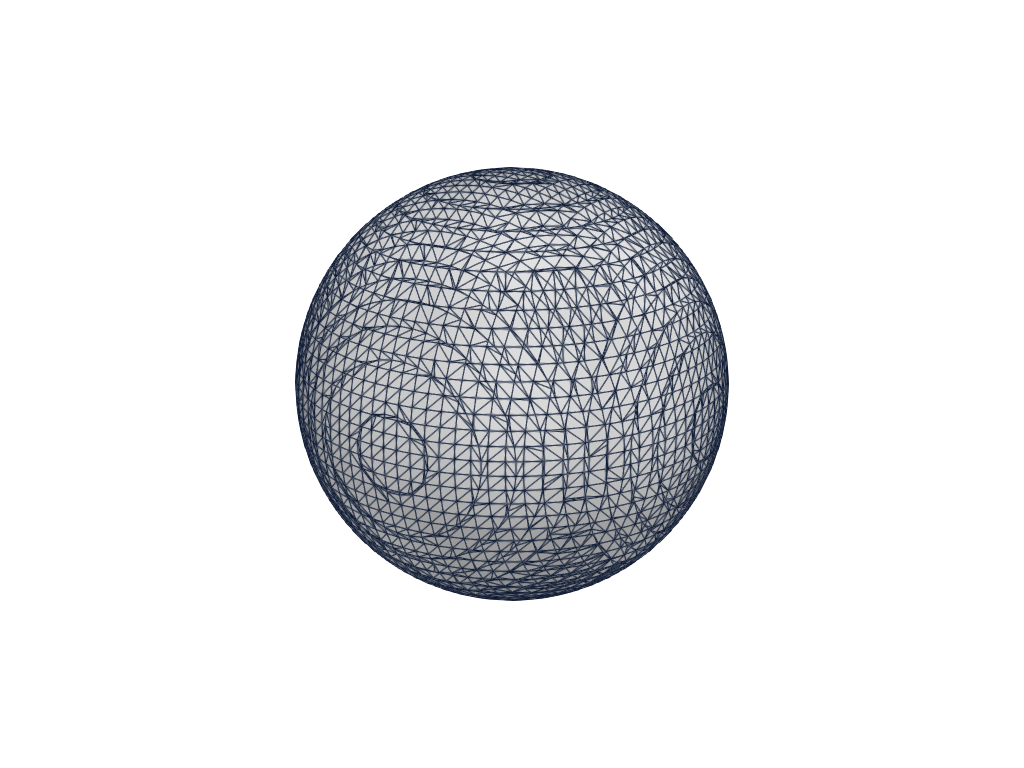
Sphere from analytic SDF
fortran
program ex_extract_isosurface
use fossil
use fossil_facet_object, only : facet_object
use penf, only : I4P, R8P
use vecfor, only : vector_R8P
implicit none

type(surface_stl_object)        :: sphere
type(facet_object), allocatable :: sphere_facets(:)
real(R8P), allocatable          :: values(:, :, :)
type(vector_R8P)                :: bmin, bmax
real(R8P)                       :: x, y, z, dx
integer(I4P), parameter         :: NG = 64_I4P
integer(I4P)                    :: i, j, k, status

allocate(values(NG, NG, NG))
dx = 4._R8P / real(NG - 1, R8P)
do k = 1_I4P, NG
   z = -2._R8P + (k - 1) * dx
   do j = 1_I4P, NG
      y = -2._R8P + (j - 1) * dx
      do i = 1_I4P, NG
         x = -2._R8P + (i - 1) * dx
         values(i, j, k) = sqrt(x**2 + y**2 + z**2) - 1._R8P  ! unit-sphere SDF
      enddo
   enddo
enddo
bmin = vector_R8P(-2._R8P, -2._R8P, -2._R8P)
bmax = vector_R8P( 2._R8P,  2._R8P,  2._R8P)
call extract_isosurface(values=values, bmin=bmin, bmax=bmax, iso=0._R8P, &
                        surface=sphere_facets, status=status)
call sphere%adopt_facets(facets=sphere_facets)
print '(A,I0,A,F8.4)', 'sphere: n_facets=', sphere%get_facets_number(), &
                       '  vol=', sphere%get_volume()  ! ≈ 4.19 = (4/3)π
endprogram ex_extract_isosurface
Cube SDF→STL roundtrip via resample_via_distance_field
fortran
program ex_resample_via_distance_field
use fossil
use penf, only : I4P, R8P
implicit none
type(surface_stl_object) :: cube_in, cube_resampled
integer(I4P)             :: status

call cube_in%load_from_file(file_name='src/tests/cube.stl', guess_format=.true.)
call cube_in%resample_via_distance_field(resolution=64_I4P, &
                                          surface_out=cube_resampled, status=status)
print '(A,I0,A,F8.4)', 'resampled cube: n_facets=', cube_resampled%get_facets_number(), &
                       '  vol=', cube_resampled%get_volume()  ! ≈ 1.0
endprogram ex_resample_via_distance_field
Visual reference
Sphere extracted from analytic SDF at 64³ grid resolution (9452 facets, volume 4.179 vs analytic 4.189):
Cube resampled through its own SDF at resolution=64 (40 364 facets, volume 1.000 — bit-exact roundtrip):
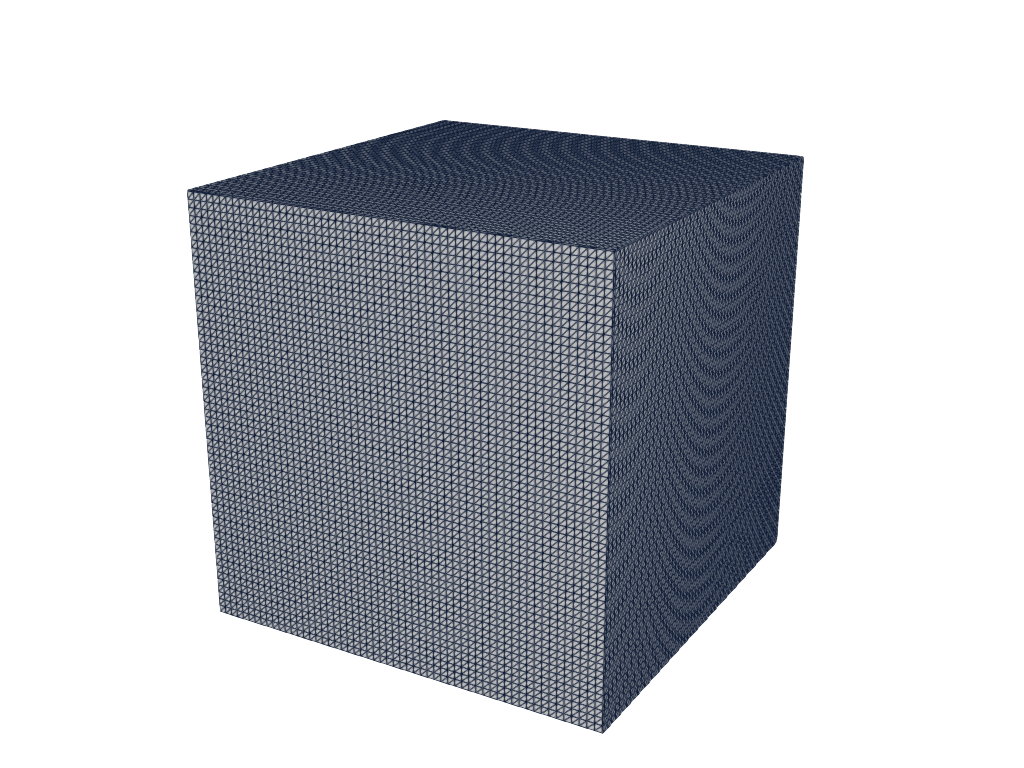
The resampled cube has far more triangles than the input (12 → 40 k) because MC tessellates by grid cell, not by silhouette. Run decimate afterwards if the count matters.
Known limitations
- Lorensen-Cline ambiguity on cases 105 / 150. The standard 256- entry MC table doesn't disambiguate the diagonally-opposite- corners-inside cases — the same case index can produce surfaces with topologically-different connectivity at adjacent cubes, occasionally leaving small holes. MC33 (Chernyaev 1995) is the documented upgrade path; for typical AMR-CFD use cases (smooth SDF, well-resolved grid), the ambiguity rarely fires.
resample_via_distance_field'ssurface_outcannot aliasself. Passing the same surface for both consumesself%facetmid-loop and produces an empty output. Always use a distinct destination surface.- Output triangle count grows as
resolution²(surface area / cell-face area). 32³ resolution typically gives a few thousand facets; 128³ gives hundreds of thousands. Plan fordecimateafter if downstream cares about count. - The output isn't exactly watertight by construction — MC's per-cell triangulation can create tiny T-junctions at refinement transitions of the input SDF.
adopt_facets'sconnect_nearby_verticesfilters most of these; the rest are closed bysanitizeif needed.
See also
surface%distance— the signed-distance query thatresample_via_distance_fieldsamples internally.decimate— the natural follow-up if the MC output is denser than the downstream pipeline can handle.alpha_wrap— the heavyweight alternative for inputs too dirty for SDF resampling to repair.
References
- Lorensen & Cline, Marching Cubes: A High Resolution 3D Surface Construction Algorithm, SIGGRAPH 1987. The reference algorithm.
- Bourke, Polygonising a scalar field, 1994 (online article). The canonical 256-entry case table FOSSIL embeds.
- Chernyaev, Marching Cubes 33: Construction of Topologically Correct Isosurfaces, GVG technical report 1995. The topology-correct upgrade path (MC33) that closes the ambiguity gap.