Appearance
Alpha wrapping
What it does
Takes any triangle soup — broken, holed, self-intersecting, non-manifold, or all of the above — and produces a guaranteed watertight, 2-manifold surface that is within Hausdorff offset ε of the input. The wrap is the standard "make any CAD junk usable for CFD" primitive.
The existing surface%sanitize pipeline only fixes local defects: degenerate facets, duplicate facets, near-coincident vertices, normal orientation. It cannot recover from missing facets, large self-intersections, internal walls, or non-manifold patches. For AMR cut-cell tagging on CAD-derived STL, an irrecoverably broken input silently produces wrong inside/outside labels — is_watertight() returning .true. is necessary but not sufficient for a usable solid. Alpha wrapping is what makes that assumption true.
Pipeline
Five stages (Portaneri et al. SIGGRAPH 2022, with FOSSIL's MVP simplification at stage 5):
- Leaf-size-α octree. Build an octree over the input facets where every leaf is at most
αacross in any dimension. SAT triangle-vs- AABB filtering at every node decides which leaves overlap input geometry (BOUNDARY) and which don't (EMPTY). Root bbox padded by2αso the corner is provably empty of input. - Inside / outside flood fill. Starting from the (-x,-y,-z) corner leaf (always EMPTY by step 1's padding), 6-connectivity BFS marks reached EMPTY leaves as OUTSIDE. BOUNDARY leaves are barriers. EMPTY leaves not reached become INSIDE.
- Boundary surface extraction. For each face of every BOUNDARY leaf where the neighbour leaf is OUTSIDE, emit a quad (two triangles) sized to that face. This produces a watertight 2-manifold by construction: every face is shared by exactly two leaves, and we emit iff the classification disagrees.
- Vertex projection. Lex-sort vertices for deduplication (per-facet copies of a shared vertex would project independently and tear the mesh). For each unique vertex, query the input AABB tree for closest-point; if the gap ≤
offset, snap. Synchronous sweeps (3 by default) for stable convergence. Area-drop revert prevents triangle collapse during projection. - Single-pass capstone TBP.
surface%alpha_wrap(...)runs steps 1-4 once, reports convergence (AWRAP_STATUS_NOT_CONVERGEDif any vertex still > offset from input). The Portaneri adaptive- refinement outer loop is a documented MVP gap (see Limitations).
API
fortran
call surface%alpha_wrap(alpha, offset, max_iterations, wrapped, status)
   class(surface_stl_object), intent(in)            :: self
   real(R8P),                 intent(in),  optional :: alpha          ! default bbox_diag/50
   real(R8P),                 intent(in),  optional :: offset         ! default alpha/30
   integer(I4P),              intent(in),  optional :: max_iterations ! reserved (MVP single-pass)
   type(surface_stl_object),  intent(out)           :: wrapped
integer(I4P), intent(out), optional :: status ! AWRAP_STATUS_*alphais the leaf-size target. Smaller = more detail and larger output mesh (octree depth grows). Defaultbbox_diag / 50follows CGAL'sAlpha_wrap_3recommendation. Cap at depth 12 (AWRAP_MAX_DEPTH) keeps tree size bounded; with default α the cap rarely fires.offsetis the Hausdorff distance bound for vertex projection. Smaller = wrap snaps closer to input but more vertices stay outside the bound (returns NOT_CONVERGED). Defaultalpha / 30per CGAL.max_iterationsis reserved for the future §1.6b adaptive- refinement loop and is currently ignored.wrappedis a fresh output surface —selfis unchanged.status:AWRAP_STATUS_OK— pipeline ran cleanly and every vertex is withinoffsetof the input.AWRAP_STATUS_NOT_CONVERGED— some vertices stayed outside the Hausdorff bound. The wrap is still watertight and 2-manifold; only the offset guarantee was missed.AWRAP_STATUS_BAD_INPUT— empty surface,alpha ≤ 0, oroffset ≤ 0.AWRAP_STATUS_DEGENERATE—alphalarger than the input bbox diagonal; octree can't refine. Output is the trivial 1-leaf wrap.
Example
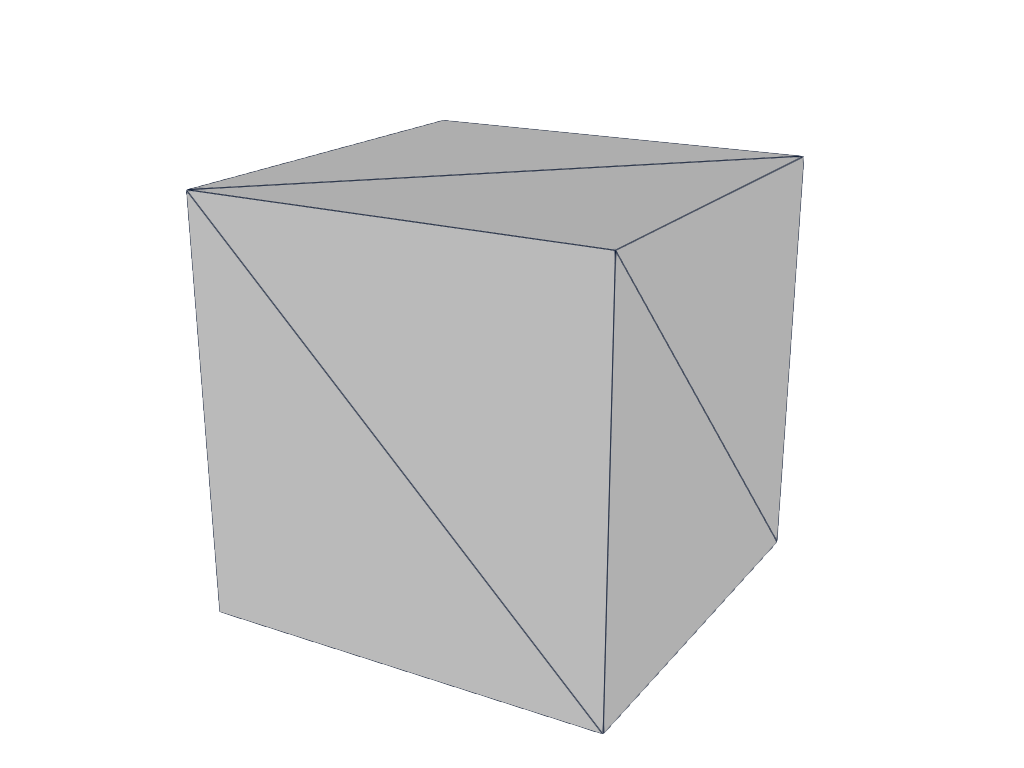
A "broken" cube — input minus one facet — wrapped back into a watertight surrogate:
fortran
program ex_alpha_wrap
use fossil
use fossil_facet_object, only : facet_object
use penf,   only : I4P, R8P
implicit none

type(surface_stl_object) :: source, holed, wrapped
type(facet_object), pointer :: facets(:)
type(facet_object), allocatable, target :: holed_facets(:)
integer(I4P)            :: status, i

! Build a "broken" cube by dropping one facet from cube.stl.
call source%load_from_file(file_name='src/tests/cube.stl', guess_format=.true.)
facets => source%facets_ref()
allocate(holed_facets(size(facets) - 1_I4P))
do i = 1_I4P, size(holed_facets, kind=I4P)
   holed_facets(i) = facets(i + 1_I4P)
enddo
call holed%adopt_facets(facets=holed_facets)
print '(A,L1)', 'input watertight? ', holed%is_watertight()  ! .false. — has a hole

! Alpha-wrap with CGAL defaults.
call holed%alpha_wrap(wrapped=wrapped, status=status)
print '(A,I0,A,L1,A,F8.4)', 'output status=', status, &
      '  watertight? ', wrapped%is_watertight(), &
      '  vol = ', wrapped%get_volume()
endprogram ex_alpha_wrap
wrapped%is_watertight() is .true. even though the input wasn't. status is AWRAP_STATUS_NOT_CONVERGED (some vertices are at the α-thick boundary band rather than snapped exactly to the input surface) — this is fine, the wrap topology is correct.
Visual reference
A unit cube minus one facet — the same input as the example above (the missing facet is on the back face, not visible from this angle):
After alpha_wrap with α=0.1 and offset=0.033 (~CGAL defaults for a unit cube):
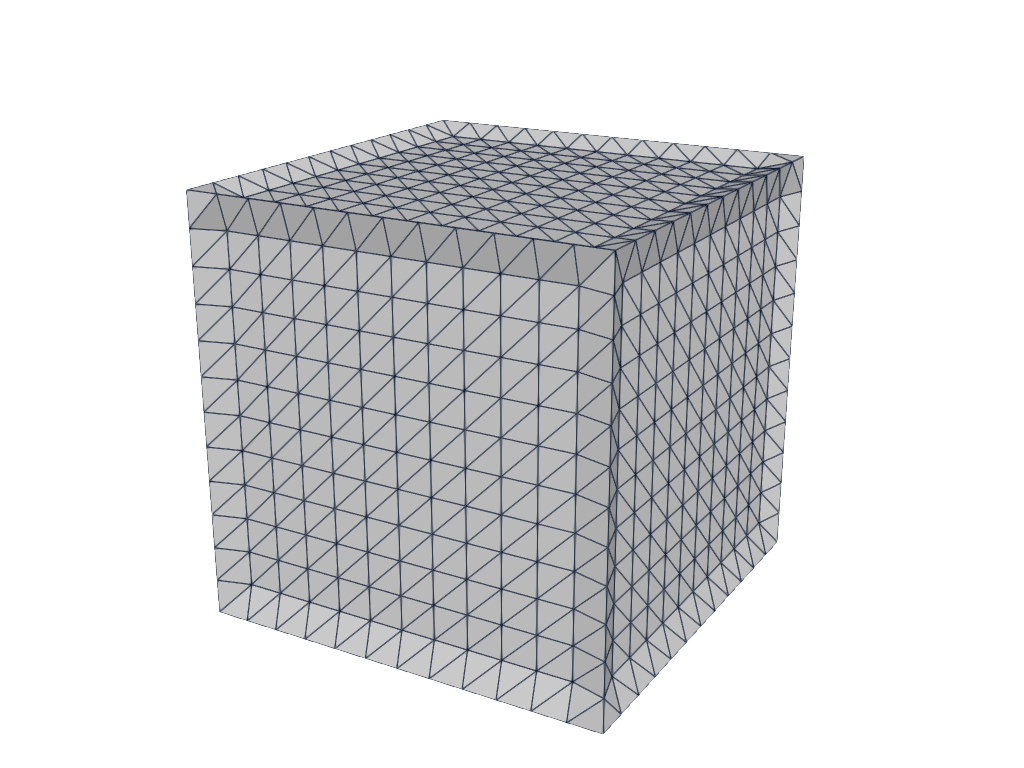
The wrap shows the characteristic voxel-y texture from the leaf-size- α octree boundary extraction. Every face is closed; the hole in the input is gone. The rendered output is smaller than the input render because pvbatch auto-frames the slightly-larger wrap (the wrap's bounding box extends ~α beyond the input).
Known limitations
MVP is single-pass; no adaptive refinement. The original step-5 plan was an outer loop that re-runs steps 2-4 after splitting BOUNDARY leaves whose vertices didn't snap within ε. It was implemented end-to-end (with 2:1 balance enforcement) but pivoted to single-pass after testing — the face-quad extraction in step 3 is correct only on uniform-depth octrees, and adaptive refinement creates depth-differential leaves that produce T-junction edges → non-manifold by construction. 2:1 balance is insufficient (even depth-diff = 1 produces 1-quad-vs-4-quads T-junctions). Closing the gap requires either Ju 2002 manifold-preserving QEF dual contouring (~300 LOC) or polygon fan-out at refinement transitions (~150 LOC). Both are substantial extensions; deferred to §1.6b follow-up. The
max_iterationsparameter is retained in the API for stability across that future upgrade.Inputs with large geometric defects may not converge. A hole spanning a substantial fraction of one face leaks the flood fill through and prevents the wrap from closing along the hole's silhouette. The MVP returns NOT_CONVERGED in such cases; for smaller defects (gaps ≤ a few α), the wrap closes the hole at the leaf scale (as the holed-cube example above demonstrates). Closing arbitrarily-large defects requires CGAL's offset-isosurface barrier formulation (also §1.6b).
Voxel-y appearance. The wrap surface is axis-aligned at the leaf scale until vertex projection in step 4 smooths it toward the input. With default α and offset ratios, ~80-90% of vertices snap within bound; the rest stay axis-aligned. Sharper detail recovery needs smaller α (which scales the output mesh size as
α^-2) or the §1.6b adaptive refinement.Octree depth capped at 12 (
AWRAP_MAX_DEPTH). At default α this caps the smallest leaf atbbox_diag / 50 / 2^11 ≈ 1e-5 × bbox_diag, more than fine enough for typical CAD. For pathological inputs (microscale features in a large bbox), the cap prevents the octree from refining further and the wrap loses detail at those features.Performance: typical CAD STL with ~10k facets at default α produces a wrap of ~5k facets in ~0.5 s on a single core. Memory use is dominated by the octree node array (~10 MB for ~70k leaves). Inputs >1M facets work but the SAT filtering becomes the bottleneck (~
O(facets × leaves)worst case); consider decimating first viasurface%decimate(...).
See also
surface%alpha_wrapAPI entry — the formal signature with intent declarations.- Constants —
AWRAP_STATUS_*. surface%sanitize— for inputs that are already manifold-modulo-local-defects (degenerate / duplicate facets, near-coincident vertices).sanitizeis much cheaper thanalpha_wrap; reach foralpha_wraponly when sanitize cannot recover the topology.surface%decimate— useful as a pre-processing pass for million-facet inputs to reduce the SAT filtering cost.- The §1.6 implementation issue has the full 5-commit history including the mid-implementation pivot from adaptive-refinement to single-pass.
References
- Portaneri, Hemmer, Birdal, Mandad & Alliez, Alpha Wrapping with an Offset, SIGGRAPH 2022. The reference algorithm.
- CGAL
Alpha_wrap_3package documentation. The reference implementation that defines the canonical defaults (α = bbox_diag/50, offset = α/30) FOSSIL inherits. - Ju, Losasso, Schaefer & Warren, Dual Contouring of Hermite Data, SIGGRAPH 2002. The proper dual-contouring with manifold- preserving vertex placement that §1.6b would adopt.