
Split blocks and balance the MPI load
Xall gives each MPI rank whole blocks. A cubed sphere has 6 blocks of two sizes, so on 10 ranks four ranks idle and the load is badly skewed. Split the blocks into more, smaller chunks first, keeping enough cells per axis for the multigrid levels you run.
The case is a cubed sphere with 33 × 64 × 33 nodes: four equatorial blocks of 32 × 16 × 32 cells and two caps of 16 × 16 × 32, 81 920 cells in all. The Python version is examples/cookbook/split_balance.py (about 2 s).
Split blocks by hand
Write the cuts in a TOML file, one [[splits]] entry per block and axis, with the cut positions as node indices:
version = 1
kind    = "split"

[[splits]]
label = "sub0"
axis  = "k"
at = [16]shore mesh sphere.stl --ni 33 --nj 64 --nk 33 --ds 1e-3 --theta-cap-deg 35 \
-o sphere --adjacency-json sphere.adjacency.json
shore split -c manual.toml sphere_*.geo --adjacency sphere.adjacency.json -o manual✓ Wrote 12 blocks + manual.adjacency.json (1 split directive(s))- One cut on
sub0along k gave 12 blocks: the cut follows every seam that contains the k axis, round the equatorial ring and into both caps, so the chunks stay point-matched. - Chunks are named
<label>__<axis><n>, for examplesub0__k0,sub0__k1; the output is<stem>_<chunk>.geoplus<stem>.adjacency.json. - Always pass the
--adjacencysidecar of the input. A.geofile holds only coordinates; without the sidecar every face is FREE, the seams are lost, andcc.parasks the overset pre-processor for donors across what was a 1-to-1 seam. - In Python,
Project.split([(label, axis, [at, ...]), ...])applies the same directives to a project's mesh.
Plan a balanced split
shore balance reads the cell counts from a .grd and writes the split TOML for you:
shore grd sphere_sub0.geo sphere_sub1.geo sphere_sub2.geo sphere_sub3.geo \
    sphere_cap_north.geo sphere_cap_south.geo -o sphere.grd
shore balance sphere.grd -o splits.toml --np 10 --ngr 3 --min-coarse-cells 4 \
    --adjacency sphere.adjacency.json
shore split -c splits.toml sphere_*.geo --adjacency sphere.adjacency.json -o split
shore grd split_*.geo -o split.grd
shore proc-input split.grd split.proc.input --np 10shore balance: 6 blocks (imbalance 200.0%) → 20 blocks (imbalance 0.00%) via 10 cut(s) across 6 block(s)
✓ Wrote 20 blocks + split.adjacency.json (10 split directive(s))
✓ Wrote split.grd (20 blocks)
...
imbalance: 0.0%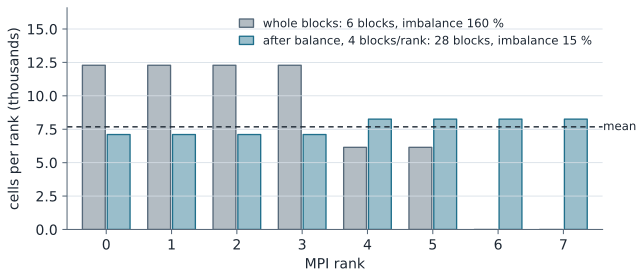
- Imbalance is
(max - min) / meanof the cells per rank. Before the split, 6 blocks on 10 ranks leave 4 ranks empty: 200 %. - The planner cuts every block into roughly equal, roughly cubic chunks, aiming at
np × --blocks-per-rankblocks (default 1.0), and chooses the same cut count on seam-linked axes so the result is conformal. The greedy cell-weighted assignment inproc-inputthen places them. shore grdpacks blocks in the order you list them, andcc.parmust use the same order.shore splitwrites the sidecar in sorted label order, which is the order the shell expandssplit_*.geoin.- The planner never fails on the tolerance (
--tolerance, default 5 %): it reports what it reached. Chunk granularity limits it. The same plan on 8 ranks gives 20 equal chunks on 8 ranks, 3 or 2 per rank, 40 % imbalance; choose--npand--blocks-per-rankso that the chunk count divides well.
The Python version builds the same sphere in a project, writes the .grd, runs the same plan through plan_balance and applies it to the project:
shapes.sphere(radius=1.0, subdivisions=4).export("sphere.stl")
p = Project()
p.load_geometry("sphere.stl")
p.build_topology("cubed_sphere", nk=33, ds=1e-3, growth=1.15, ni=33, nj=64,
                 theta_cap=np.deg2rad(35.0))  # fmt: skip
p.march()
p.write_geo("sphere")
p.write_adjacency("sphere.adjacency.json")
labels = [b.label for b in p.mesh.blocks]
p.write_grd("sphere.grd", [f"sphere_{label}.geo" for label in labels])plan = plan_balance(
"sphere.grd", np=10, ngr=3, min_coarse_cells=4, adjacency_path="sphere.adjacency.json"
)
Path("splits.toml").write_text(plan.to_toml())
before, after = plan.initial_summary, plan.final_summary
print(f"{before.n_blocks} blocks, imbalance {before.imbalance:.0%} -> "
f"{after.n_blocks} blocks, imbalance {after.imbalance:.0%}") # fmt: skip
print("cuts:", plan.splits[:3], "...")p.split([(label, axis, [at]) for label, axis, at in plan.splits]) # cuts follow the seams
p.write_geo("split", per_block=True)
p.write_adjacency("split.adjacency.json")
chunks = [b.label for b in p.mesh.blocks]
p.write_grd("split.grd", [f"split_{label}.geo" for label in chunks])
p.write_proc_input("split.grd", "split.proc.input", np=10)
print(f"{len(chunks)} blocks:", ", ".join(chunks[:4]), "...")6 blocks, imbalance 200% -> 20 blocks, imbalance 0%
cuts: [('sub0', 'i', 16), ('sub0', 'k', 16), ('sub1', 'i', 16)] ...
20 blocks: sub0__i0__k0, sub0__i0__k1, sub0__i1__k0, sub0__i1__k1 ...Keep the multigrid floor
Xall coarsens each block ngr - 1 times by 2. The planner keeps every chunk axis at least min_coarse_cells × 2^(ngr-1) cells and divisible by 2^(ngr-1):
--ngr | --min-coarse-cells | Floor per axis | Effect here |
|---|---|---|---|
| 3 | 4 | 16 cells, multiple of 4 | 32-cell axes cut once, 16-cell axes not |
| 4 | 4 | 32 cells, multiple of 8 | no cut possible, warning |
shore balance sphere.grd -o t.toml --np 4 --ngr 4 --min-coarse-cells 4 \
--adjacency sphere.adjacency.jsonUserWarning: plan_balance: 6 input block(s) already below the multigrid floor (>= 32 cells/axis,
divisible by 8) for ngr=4, min_coarse_cells=4 — they cannot be made conformal at this level count.
...
shore balance: 6 blocks (imbalance 40.0%) → 6 blocks (imbalance 40.00%) via 0 cut(s) across 0 block(s)- Pass
--adjacency: the floor is then checked against the cuts as they propagate through the seams, not only block by block. - When the floor is not met the planner warns and returns its best plan; coarsen less (
--ngr), lower--min-coarse-cells, or build the grid with more cells.
See also
- Load balancing: seam propagation, per-axis cut counts, the floor, rank assignment.
- Split after overset: when the split must come after the donor search.
- Multi-component Xall run.
- CLI:
shore split,shore balance,shore grd,shore proc-input. - API:
plan_balance,split_blocks.