
Check grid quality
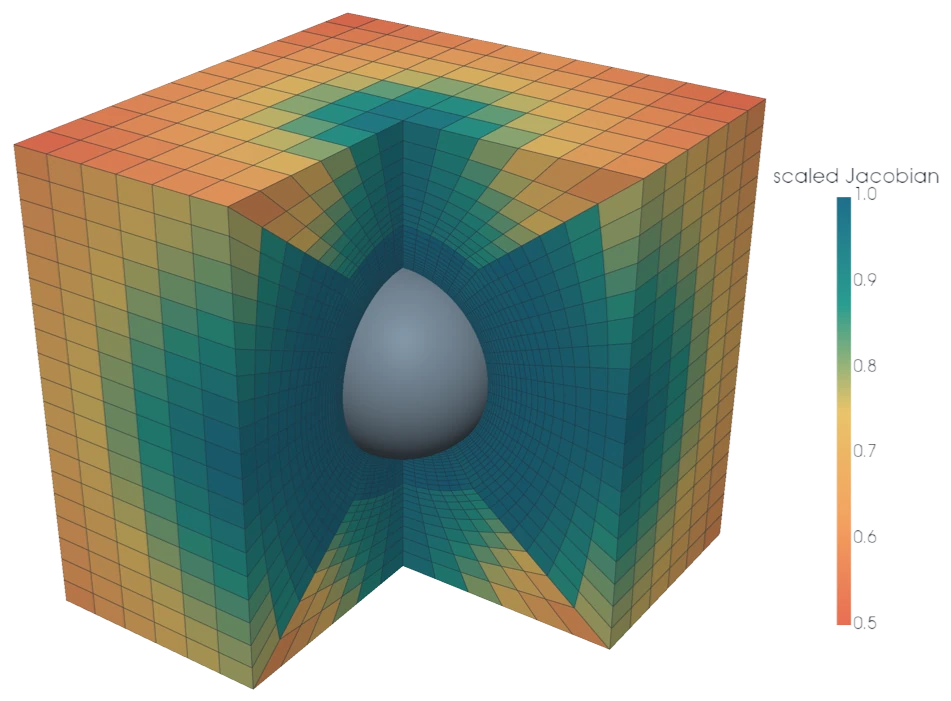
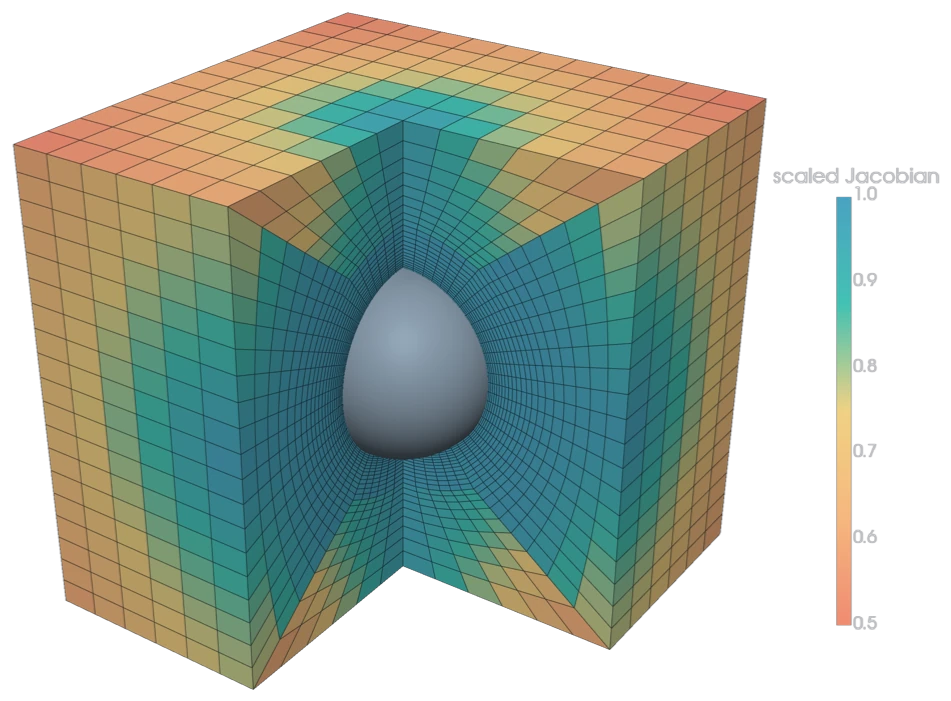
Check a grid before you hand it to the solver: no folded cells, a bounded scaled Jacobian, wall-normal lines that leave the wall straight, and a smooth growth away from it. shore check gives the folded-cell test on a .geo file; shore.quality gives the metrics on any block list or node array.
The code is examples/cookbook/quality.py (about 5 s). It marches a cubed sphere first:
shapes.sphere(radius=1.0, subdivisions=4).export("sphere.stl")
p = Project()
p.load_geometry("sphere.stl")
p.build_topology("cubed_sphere", nk=33, ds=1e-3, growth=1.15, ni=33, nj=64,
                 theta_cap=np.deg2rad(35.0))  # fmt: skip
p.march()
p.write_geo("sphere")
blocks = p.mesh.blocks
Check a .geo file for folded cells
shore check sphere_cap_north.geo Jacobian check -
sphere_cap_north.geo
┏━━━━━━━┳━━━━━━━━━━━━┳━━━━━━━━┓
┃ Layer ┃ jmin ┃ Status ┃
┡━━━━━━━╇━━━━━━━━━━━━╇━━━━━━━━┩
│ 1 │ 1.6730e-06 │ ok │
│ 2 │ 1.9557e-06 │ ok │
...
✓ All Jacobians positive.jminis the smallest triple product(e_i × e_j) · e_kof the cells between layersk-1andk: a volume, in geometry units cubed, not a normalised measure.- A layer with
jmin <= 0holds a folded cell; the command then exits with code 1, so it can gate a script. warnmarks layers with0 < jmin < --warn-threshold(default1e-6). Thin wall cells trip it on sound grids: a first cell of5e-5on a unit sphere givesjminnear1e-7. Scale the threshold to your cell volumes (--warn-threshold 1e-9) or read the scaled Jacobian below.Mesh.check()returns the same layer minima as a dict per block.
Summarise a whole grid
for key, value in quality.summary(blocks).items():
print(f"{key:28s} {value:.4g}")scaled_jacobian_min 0.7695
folded_cells 0
wall_orthogonality_max_deg 18.43
wall_orthogonality_mean_deg 14.64
aspect_ratio_max 165.7
k_growth_max 1.271| Key | Metric | Good |
|---|---|---|
scaled_jacobian_min | smallest corner scaled Jacobian of any cell (1 = orthogonal corner, <= 0 = folded) | > 0.3 for a marched grid |
folded_cells | cells with scaled Jacobian <= 0 | 0 |
wall_orthogonality_*_deg | angle between the first k-segment and the wall-layer normal | a few degrees |
aspect_ratio_max | longest over shortest edge of a cell | large at the wall by design |
k_growth_max | largest ratio of consecutive k-segments | <= 1.2–1.3 |
The "good" column gives rules of thumb, not SHORE limits; your solver decides. summary takes HexBlocks or bare (ni, nj, nk, 3) arrays.
Compare blocks and find the worst cell
The functions behind summary return one value per cell or node, so you can slice them per block, per layer or per region:
print(f"{'block':10s} {'min SJ':>7s} {'max wall deg':>12s} {'max AR':>8s} {'max growth':>10s}")
for b in blocks:
    sj = quality.scaled_jacobian(b.nodes)
    wall = quality.k_orthogonality_deg(b.nodes, 0)
    ar = quality.aspect_ratio(b.nodes)
    g = quality.k_growth(b.nodes)
print(f"{b.label:10s} {sj.min():7.3f} {wall.max():12.2f} {ar.max():8.0f} {g.max():10.3f}")block min SJ max wall deg max AR max growth
sub0 0.771 18.43 166 1.242
sub1 0.770 18.43 166 1.239
sub2 0.771 18.43 166 1.242
sub3 0.770 18.43 166 1.239
cap_north 0.917 18.24 82 1.271
cap_south 0.917 18.24 82 1.271worst = min(blocks, key=lambda b: quality.scaled_jacobian(b.nodes).min())
sj = quality.scaled_jacobian(worst.nodes)
i, j, k = np.unravel_index(np.argmin(sj), sj.shape)
centre = worst.nodes[i : i + 2, j : j + 2, k : k + 2].reshape(-1, 3).mean(axis=0)
print(f"worst cell: block {worst.label}, cell ({i}, {j}, {k}), SJ {sj[i, j, k]:.3f}")
print(f" centre {np.round(centre, 4)}, {np.count_nonzero(sj < 0.5)} cells below 0.5")worst cell: block sub3, cell (31, 15, 0), SJ 0.770
centre [ 0.5801 -0.0189 -0.8134], 0 cells below 0.5| Function | Shape of the result |
|---|---|
scaled_jacobian(nodes) | (ni-1, nj-1, nk-1), per cell |
aspect_ratio(nodes) | (ni-1, nj-1, nk-1), per cell |
k_orthogonality_deg(nodes, k=0) | (ni, nj), per node of layer k |
k_spacing(nodes) | (ni, nj, nk-1), per k-segment |
k_growth(nodes) | (ni, nj, nk-2) |
k_angle_deg(nodes, directions, k=0) | (ni, nj), against given directions |
k_orthogonality_deg uses a one-sided layer normal on block edges; on a multi-block wall k_angle_deg against the body normals (Body.normals(points)) avoids that bias.
Compare march settings
The table above shows wall lines tilted by 14.6° on average. The default algebraic march with smooth_mode="limited" lets the smoothing move a node sideways by up to a quarter of its step, atan(0.25) = 14°, and on a sphere almost every first-layer node uses that allowance. Measure before you choose:
# The same grid marched three ways: compare the wall-normal lines.
for options in ({}, {"smooth_iters": 0}, {"march_scheme": "hyperbolic"}):
    q = Project()
    q.load_geometry("sphere.stl")
    q.build_topology("cubed_sphere", nk=33, ds=1e-3, growth=1.15, ni=33, nj=64,
                     theta_cap=np.deg2rad(35.0))  # fmt: skip
    q.march(**options)
    s = quality.summary(q.mesh.blocks)
    print(
        f"{options!s:30s} wall mean {s['wall_orthogonality_mean_deg']:5.2f} deg, "
        f"max {s['wall_orthogonality_max_deg']:5.2f} deg, min SJ {s['scaled_jacobian_min']:.3f}"
){} wall mean 14.64 deg, max 18.43 deg, min SJ 0.770
{'smooth_iters': 0} wall mean 0.32 deg, max 2.76 deg, min SJ 0.773
{'march_scheme': 'hyperbolic'} wall mean 0.34 deg, max 2.74 deg, min SJ 0.747- On a smooth convex body,
march_scheme="hyperbolic"(--march-scheme hyperbolic) or no smoothing gives wall lines within 3° of the normal. - Smoothing earns its place on concave regions and at sharp features, where unsmoothed layers fold; check the folded-cell count after each change.
Check .geo files from any source
# The same metrics on .geo files written by SHORE or any other tool.
nodes = [read_geo(path) for path in sorted(Path().glob("sphere_*.geo"))]
print(f"{len(nodes)} .geo files, min SJ {quality.summary(nodes)['scaled_jacobian_min']:.3f}")6 .geo files, min SJ 0.770read_geo returns the (ni, nj, nk, 3) array of one block, so the metrics work on grids from other generators too.
See also
- Grid quality: the definitions.
- Marching schemes: smoothing, the limiter and the hyperbolic scheme.
- Set the wall-normal spacing.
- CLI:
shore check,shore info,shore export(VTK with the Jacobian, for ParaView). - API:
shore.quality.