Appearance
8. Restart
A long run is split in jobs: each one restarts from the last output of the previous one. heat reads the collection of chapter 4, takes its last file, and reads the grid, the temperature, the time and the cycle back:
f90
! the last dataset of the time series
error = series%initialize(filename='heat.pvd', action='read')
error = series%get_datasets(timestep=timestep, file=file)
error = series%finalize()
! its grid, temperature, time and cycle
error = last%initialize(filename=trim(file(size(file))), action='read')
error = last%xml_reader%read_geo(x=x, y=y, z=z)
error = last%xml_reader%read_dataarray(location='node', data_name='temperature', x=values)
error = last%xml_reader%read_dataarray(location='field', data_name='TIME', x=time_read)
error = last%xml_reader%read_dataarray(location='field', data_name='CYCLE', x=cycle_read)
error = last%finalize()
n = size(x)
t = reshape(values, [n, n, n])
time = time_read(1)
start = int(cycle_read(1), I4P)
print '(A,A,A,I0,A,ES10.3)', 'restart from ', trim(file(size(file))), ': cycle ', start, ', time ', timepvd_filewithaction='read'returns the time steps and the files of the collection.vtk_filewithaction='read'indexes the file without loading it; eachread_*then loads one array: the coordinates, the temperature (flattened:reshapeit back), the field data.
Then it continues the run, appending the new outputs to the same collection:
f90
! continue the run, appending to the same collection
error = series%initialize(filename='heat.pvd', action='append')
do cycle=start + 1, start + steps
  call step(t)
  time = time + dt
  if (mod(cycle, every) == 0) then
    error = write_file(filename='heat_'//trim(strz(cycle, 4))//'.vtr', time=time, cycle=cycle)
    error = series%write_dataset(filename='heat_'//trim(strz(cycle, 4))//'.vtr', timestep=time)
  endif
enddo
error = series%finalize()
heat_8.f90
f90
program heat
!< Tutorial, chapter 8: restart the run of chapter 4 from its last file, and continue its time series.
use penf, only : I4P, I8P, R8P, strz
use vtk_fortran, only : pvd_file, vtk_file
implicit none
integer(I4P), parameter :: steps=36          ! more time steps
integer(I4P), parameter :: every=2
real(R8P),        allocatable :: x(:), y(:), z(:), t(:,:,:), values(:), time_read(:), timestep(:)
integer(I8P),     allocatable :: cycle_read(:)
character(len=:), allocatable :: file(:)
type(pvd_file)          :: series
type(vtk_file)          :: last
real(R8P)               :: time, h, dt
integer(I4P)            :: n, cycle, start, error

! the last dataset of the time series
error = series%initialize(filename='heat.pvd', action='read')
error = series%get_datasets(timestep=timestep, file=file)
error = series%finalize()
! its grid, temperature, time and cycle
error = last%initialize(filename=trim(file(size(file))), action='read')
error = last%xml_reader%read_geo(x=x, y=y, z=z)
error = last%xml_reader%read_dataarray(location='node', data_name='temperature', x=values)
error = last%xml_reader%read_dataarray(location='field', data_name='TIME', x=time_read)
error = last%xml_reader%read_dataarray(location='field', data_name='CYCLE', x=cycle_read)
error = last%finalize()
n = size(x)
t = reshape(values, [n, n, n])
time = time_read(1)
start = int(cycle_read(1), I4P)
print '(A,A,A,I0,A,ES10.3)', 'restart from ', trim(file(size(file))), ': cycle ', start, ', time ', time
h = x(2) - x(1)
dt = 0.15_R8P*h**2

! continue the run, appending to the same collection
error = series%initialize(filename='heat.pvd', action='append')
do cycle=start + 1, start + steps
  call step(t)
  time = time + dt
  if (mod(cycle, every) == 0) then
    error = write_file(filename='heat_'//trim(strz(cycle, 4))//'.vtr', time=time, cycle=cycle)
    error = series%write_dataset(filename='heat_'//trim(strz(cycle, 4))//'.vtr', timestep=time)
  endif
enddo
error = series%finalize()
print '(A,I0,A,ES10.3,A,F6.3)', 'heat.pvd: ', size(file) + steps/every, ' files, until time ', time, &
      ', maximum temperature ', maxval(t)
contains
  function write_file(filename, time, cycle) result(error)
  !< Write the temperature at a time step, with its time and cycle.
  character(*), intent(in) :: filename
  real(R8P),    intent(in) :: time
  integer(I4P), intent(in) :: cycle
  integer(I4P)             :: error
  type(vtk_file)           :: a_vtk_file

  error = a_vtk_file%initialize(format='raw', filename=filename, mesh_topology='RectilinearGrid', &
                                nx1=1, nx2=n, ny1=1, ny2=n, nz1=1, nz2=n, compressor='zlib')
  error = a_vtk_file%xml_writer%write_fielddata(action='open')
  error = a_vtk_file%xml_writer%write_fielddata(data_name='TIME', x=time)
  error = a_vtk_file%xml_writer%write_fielddata(data_name='CYCLE', x=int(cycle, I8P))
  error = a_vtk_file%xml_writer%write_fielddata(action='close')
  error = a_vtk_file%xml_writer%write_piece(nx1=1, nx2=n, ny1=1, ny2=n, nz1=1, nz2=n)
  error = a_vtk_file%xml_writer%write_geo(x=x, y=y, z=z)
  error = a_vtk_file%xml_writer%write_dataarray(location='node', action='open', scalars='temperature')
  error = a_vtk_file%xml_writer%write_dataarray(data_name='temperature', x=t, one_component=.true.)
  error = a_vtk_file%xml_writer%write_dataarray(location='node', action='close')
  error = a_vtk_file%xml_writer%write_piece()
  error = a_vtk_file%finalize()
  endfunction write_file

  subroutine step(t)
  !< Advance the temperature by one explicit time step of the heat equation; the walls stay at 0.
  real(R8P), intent(inout) :: t(:,:,:)

  t(2:n-1,2:n-1,2:n-1) = t(2:n-1,2:n-1,2:n-1) + dt/h**2*(t(1:n-2,2:n-1,2:n-1) + t(3:n,2:n-1,2:n-1) + &
                                                          t(2:n-1,1:n-2,2:n-1) + t(2:n-1,3:n,2:n-1) + &
                                                          t(2:n-1,2:n-1,1:n-2) + t(2:n-1,2:n-1,3:n) - 6*t(2:n-1,2:n-1,2:n-1))
  endsubroutine step
endprogram heat
Running it
$ heat
restart from heat_0036.vtr: cycle 36, time  1.021E-02
heat.pvd: 37 files, until time  2.042E-02, maximum temperature  0.216
The end of the collection, with the restarted outputs:
$ tail -n 5 heat.pvd
    <DataSet timestep="0.01928166351606807" part="0" file="heat_0068.vtr"/>
    <DataSet timestep="0.019848771266540662" part="0" file="heat_0070.vtr"/>
    <DataSet timestep="0.020415879017013253" part="0" file="heat_0072.vtr"/>
  </Collection>
</VTKFile>
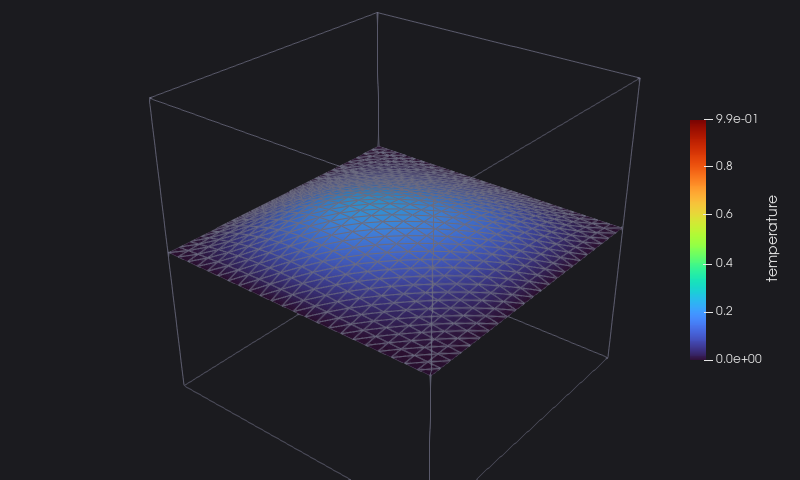
The last output, on the same scale as the animation of chapter 4: the cube has almost cooled down.
What you learned
Every file VTKFortran writes can be read back: action='read', then read_geo, read_dataarray and the other readers; pvd_file reads and appends to a collection. Reference: Reading files, Multi-block and time series files.
This is the end of the tutorial: the reference has every procedure and argument.