Appearance
5. An unstructured mesh
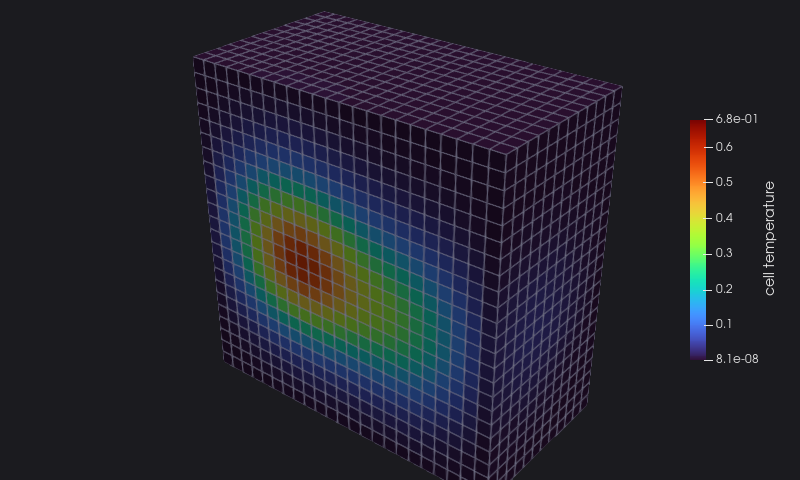
Real meshes are rarely boxes. An unstructured grid lists its points one by one and its cells by the ids of their points, so any shape fits: here the same cube, as 12167 hexahedra, a step toward the meshes of a real solver.
f90
! the points, numbered from 0 with i running fastest
do k=1, n ; do j=1, n ; do i=1, n
  px(id(i,j,k) + 1) = x(i) ; py(id(i,j,k) + 1) = x(j) ; pz(id(i,j,k) + 1) = x(k)
enddo ; enddo ; enddo
! the cells: hexahedra (VTK type 12), their 8 points in the VTK order, bottom face then top face
c = 0
do k=1, n - 1 ; do j=1, n - 1 ; do i=1, n - 1
  c = c + 1
  connect(8*c-7:8*c) = [id(i,j,k), id(i+1,j,k), id(i+1,j+1,k), id(i,j+1,k), &
                        id(i,j,k+1), id(i+1,j,k+1), id(i+1,j+1,k+1), id(i,j+1,k+1)]
  offset(c) = 8*c
  tc(c) = sum(t(i:i+1,j:j+1,k:k+1))/8  ! the mean of its points
enddo ; enddo ; enddo
cell_type = 12_I1P- The points are numbered from 0; each cell lists its points in the order VTK expects for its type (a hexahedron, type 12: the bottom face, then the top face).
offsetis the end of each cell inconnect; with cells of different types, it is how the reader splits the list.- The cell data have one value per cell: here the mean temperature of its points.
f90
error = a_vtk_file%initialize(format='raw', filename='heat.vtu', mesh_topology='UnstructuredGrid', compressor='zlib')
error = a_vtk_file%xml_writer%write_piece(np=np, nc=nc)
error = a_vtk_file%xml_writer%write_geo(np=np, nc=nc, x=px, y=py, z=pz)
error = a_vtk_file%xml_writer%write_connectivity(nc=nc, connectivity=connect, offset=offset, cell_type=cell_type)
error = a_vtk_file%xml_writer%write_dataarray(location='node', action='open')
error = a_vtk_file%xml_writer%write_dataarray(data_name='temperature', x=reshape(t, [np]))
error = a_vtk_file%xml_writer%write_dataarray(location='node', action='close')
error = a_vtk_file%xml_writer%write_dataarray(location='cell', action='open')
error = a_vtk_file%xml_writer%write_dataarray(data_name='cell_temperature', x=tc)
error = a_vtk_file%xml_writer%write_dataarray(location='cell', action='close')
error = a_vtk_file%xml_writer%write_piece()
error = a_vtk_file%finalize()
heat_5.f90
f90
program heat
!< Tutorial, chapter 5: the cube as an unstructured grid of hexahedra, with point and cell data.
use penf, only : I1P, I4P, R8P
use vtk_fortran, only : vtk_file
implicit none
integer(I4P), parameter :: n=24
integer(I4P), parameter :: np=n**3, nc=(n - 1)**3 ! points and cells
real(R8P),    parameter :: h=1._R8P/(n - 1)
real(R8P),    parameter :: dt=0.15_R8P*h**2
real(R8P)               :: x(n), t(n,n,n)
real(R8P)               :: px(np), py(np), pz(np) ! coordinates of each point
real(R8P)               :: tc(nc)                 ! temperature of each cell
integer(I4P)            :: connect(8*nc), offset(nc)
integer(I1P)            :: cell_type(nc)
type(vtk_file)          :: a_vtk_file
integer(I4P)            :: i, j, k, c, cycle, error

x = [(real(i - 1, R8P)/(n - 1), i=1, n)]
do k=1, n ; do j=1, n ; do i=1, n
  t(i,j,k) = blob(x(i), x(j), x(k), [0.35_R8P, 0.4_R8P, 0.5_R8P]) + 0.6_R8P*blob(x(i), x(j), x(k), [0.7_R8P, 0.65_R8P, 0.45_R8P])
enddo ; enddo ; enddo
t(1,:,:) = 0 ; t(n,:,:) = 0 ; t(:,1,:) = 0 ; t(:,n,:) = 0 ; t(:,:,1) = 0 ; t(:,:,n) = 0
do cycle=1, 10
  call step(t)
enddo

! the points, numbered from 0 with i running fastest
do k=1, n ; do j=1, n ; do i=1, n
  px(id(i,j,k) + 1) = x(i) ; py(id(i,j,k) + 1) = x(j) ; pz(id(i,j,k) + 1) = x(k)
enddo ; enddo ; enddo
! the cells: hexahedra (VTK type 12), their 8 points in the VTK order, bottom face then top face
c = 0
do k=1, n - 1 ; do j=1, n - 1 ; do i=1, n - 1
  c = c + 1
  connect(8*c-7:8*c) = [id(i,j,k), id(i+1,j,k), id(i+1,j+1,k), id(i,j+1,k), &
                        id(i,j,k+1), id(i+1,j,k+1), id(i+1,j+1,k+1), id(i,j+1,k+1)]
  offset(c) = 8*c
  tc(c) = sum(t(i:i+1,j:j+1,k:k+1))/8  ! the mean of its points
enddo ; enddo ; enddo
cell_type = 12_I1P

error = a_vtk_file%initialize(format='raw', filename='heat.vtu', mesh_topology='UnstructuredGrid', compressor='zlib')
error = a_vtk_file%xml_writer%write_piece(np=np, nc=nc)
error = a_vtk_file%xml_writer%write_geo(np=np, nc=nc, x=px, y=py, z=pz)
error = a_vtk_file%xml_writer%write_connectivity(nc=nc, connectivity=connect, offset=offset, cell_type=cell_type)
error = a_vtk_file%xml_writer%write_dataarray(location='node', action='open')
error = a_vtk_file%xml_writer%write_dataarray(data_name='temperature', x=reshape(t, [np]))
error = a_vtk_file%xml_writer%write_dataarray(location='node', action='close')
error = a_vtk_file%xml_writer%write_dataarray(location='cell', action='open')
error = a_vtk_file%xml_writer%write_dataarray(data_name='cell_temperature', x=tc)
error = a_vtk_file%xml_writer%write_dataarray(location='cell', action='close')
error = a_vtk_file%xml_writer%write_piece()
error = a_vtk_file%finalize()
print '(A,I0,A,I0,A)', 'heat.vtu: ', np, ' points, ', nc, ' hexahedra'
contains
  elemental function id(i, j, k)
  !< The id of the point (i,j,k), from 0.
  integer(I4P), intent(in) :: i, j, k
  integer(I4P)             :: id

  id = (i - 1) + (j - 1)*n + (k - 1)*n*n
  endfunction id

  subroutine step(t)
  !< Advance the temperature by one explicit time step of the heat equation; the walls stay at 0.
  real(R8P), intent(inout) :: t(:,:,:)

  t(2:n-1,2:n-1,2:n-1) = t(2:n-1,2:n-1,2:n-1) + dt/h**2*(t(1:n-2,2:n-1,2:n-1) + t(3:n,2:n-1,2:n-1) + &
                                                          t(2:n-1,1:n-2,2:n-1) + t(2:n-1,3:n,2:n-1) + &
                                                          t(2:n-1,2:n-1,1:n-2) + t(2:n-1,2:n-1,3:n) - 6*t(2:n-1,2:n-1,2:n-1))
  endsubroutine step

  pure function blob(x, y, z, centre) result(t)
  !< A hot blob: a Gaussian bump of temperature 1 at its centre.
  real(R8P), intent(in) :: x, y, z, centre(3)
  real(R8P)             :: t

  t = exp(-((x - centre(1))**2 + (y - centre(2))**2 + (z - centre(3))**2)/0.04_R8P)
  endfunction blob
endprogram heat
Running it
$ heat
heat.vtu: 13824 points, 12167 hexahedra
The cells, coloured by their temperature, cut in half:
What you learned
Points, connectivity, offsets and types make an unstructured grid; cell data are written between open and close of the cell location. Reference: Unstructured Grid.
Next: 6. Going parallel.