Many projects
A portability layer used by a string library, used by a parser, used by your application: each in its own repository, with its own tags, CI and boilerplate, and every change at the bottom rippling upwards. fobis ecosystem manages such a family of FoBiS projects as a whole: it shows the state of every repository, runs commands across them in dependency order, builds the dependents against an unreleased change, and releases them as a train. fobis scaffold keeps their CI workflows, scripts and documentation configuration identical. The outputs below come from a private three-project demo you can build in a minute: see Try it offline.
How it works:
- The registry. The ecosystem is an explicit list of local repositories in your user configuration,
[ecosystem] rootandprojects. A project is a git repository with afobosfile; its name is its directory name. Nothing is managed until you register it. - The graph. The edges come from each project's own fobos
[dependencies], the sectionfobis fetchreads: a dependency is an ecosystem dependency when its key or the repository name of its URL matches a registered project (case-insensitively), or when it is apath=dependency whose directory is one. Any other dependency is external: listed, not managed. - The release order. Projects are grouped in levels, each one level above its deepest dependency. Every acting command walks the projects in this order, dependencies first.
- The release rule. A project needs a release when a commit since its latest tag changes a file outside
docs/* .github/* *.md scripts/*; the Conventional Commits types of those commits give the bump. - Nothing written without consent.
discover,graph,dashboardandimpactonly read (the dashboard runsgit fetch, which updates remote-tracking refs only);checkbuilds copies. Onlyreleasecommits and pushes, after you approve the plan, and a confirmation that cannot be answered (no terminal) counts as no.
Tutorial: the ecosystem track. Reference: ecosystem, scaffold.

Register the projects
The registry lives in ~/.config/fobis/config.ini ($XDG_CONFIG_HOME/fobis/config.ini when set; --config FILE on any subcommand reads another):
[ecosystem]
; the directory the projects live in
root     = ~/fortran
; names under root, or paths; whitespace or newline separated
projects = PENF FACE BeFoR64 StringiFor
           FLAP
discover lists the git repositories with a fobos file directly under the root (no recursion) that are not registered yet, and prints the command that would register them. Pick the ones you want, not necessarily all:
$ fobis ecosystem discover
Unregistered FoBiS projects under ~/eco:
  app
  core
  mathx

Register the ones you want to manage (not necessarily all):
fobis ecosystem add app core mathx$ fobis ecosystem add core mathx app
Registered core, mathx, app in ~/eco/.config/fobis/config.ini
See where they sit: fobis ecosystem graphfobis ecosystem discover --root ~/work # scan another directory
fobis ecosystem add FiNeR ~/work/MyLib # names under root, or any path
fobis ecosystem remove FiNeR # the repository itself is not touched- The name identifies the project.
addaccepts only git repositories with a fobos file whose directory name no registered project has; an already registered one is reported and skipped. A project directly underrootis written as its bare name, any other as a~/...or absolute path. - All or nothing. One invalid argument and the configuration is not touched (exit 1).
removenotes the projects that still depend on the one removed: it becomes an external dependency for them. - Your comments survive.
addandremoverewrite only theprojectskey (creating the section or the file when missing), atomically; long lists wrap onto continuation lines. - No inline comments in the configuration:
FLAP ; the parserregisters;,theandparseras projects. - Two registered directories with the same name: the second is ignored, with a warning.
The graph and the release order
$ fobis ecosystem graph
Release order (dependencies first)
   1. core  (level 0)
   2. mathx  (level 1)
   3. app  (level 2)

Dependency tree
app
|-- mathx
|   `-- core
`-- core
Level 0 holds the projects with no ecosystem dependency; releasing level by level never releases a project before one of its dependencies. A subtree shown already is marked (*), and the external dependencies are listed last.
fobis ecosystem graph --json # projects (depends_on, dependents, external), levels, release_order, cycle- A dependency cycle is printed as
dependency cycle, not ordered: A, Band its projects are left out of the release order; the acting commands still visit them, after all the others.graphexits 0 all the same. - Exit 1 when no project is registered, for every subcommand that reads the registry.
The dashboard
One row per project: git state, release state, CI, boilerplate drift, dependency pins.
$ fobis ecosystem dashboard --no-ci
Project  Branch  Tree   Upstream  Version / tag    Unreleased           CI       Drift  Pins
-------  ------  -----  --------  ---------------  -------------------  -------  -----  -----------------------
core     master  clean  in sync   v1.0.0 / v1.0.0  1 (minor -> v1.1.0)  unknown  0      -
mathx    master  clean  in sync   v1.0.0 / v1.0.0  1, none to release   unknown  0      core stale
app master clean in sync v1.0.0 / v1.0.0 0 unknown 0 mathx stale, core stale| Column | Shows | Look at it when |
|---|---|---|
| Tree | clean, or the number of changed and untracked files | not clean |
| Upstream | in sync, +ahead/-behind, or no upstream | not in sync |
| Version / tag | the VERSION file (else a literal fobos [project] version) against the latest reachable tag | they differ (highlighted) |
| Unreleased | commits since the tag, how many are releasable, the bump and the next version | something to release |
| CI | GitHub Actions at HEAD: passing, failing, running, none (no run), not pushed, unknown | failing |
| Drift | scaffold-managed files not in sync, project-owned ones excluded (? when it cannot be computed) | not 0 |
| Pins | the ecosystem dependencies not at their head, with their state | stale, unlocked, diverged |
The Unreleased cell reads 0; N (minor -> v1.1.0) when every commit is releasable; N, R to release (...); or N, none to release when only docs or CI changed. CI is the latest run of every workflow for the HEAD commit (a re-run supersedes the previous one): failing when any concluded otherwise than success, skipped or neutral, running while any is not completed.
A pin compares the commit each project locked in <deps_dir>/fobos.lock (written by fobis fetch) with the dependency's remote default-branch head. Ecosystem projects usually follow the default branch of their dependencies, so a fix at the bottom reaches the dependents without a cascade of version bumps; the pin says whether they are built against it:
| Pin | Meaning | Fix |
|---|---|---|
current | built against the dependency's head | |
stale | the head has moved on since the last fetch | fobis ecosystem fetch |
ahead | the lock is newer than the head FoBiS knows | git fetch the dependency (drop --no-fetch) |
diverged | lock and head on unrelated histories | inspect the dependency |
unlocked | the dependency was never fetched | fobis fetch in the project |
unknown | the dependency has no remote head | push the dependency |
NAME at DIR | a path= dependency, used as it is in its directory |
fobis ecosystem dashboard                # git fetch in every project first, then the table
fobis ecosystem dashboard --no-fetch     # offline: upstream, CI and pins as of the last fetch
fobis ecosystem dashboard --no-ci        # do not ask GitHub (CI reads unknown)
fobis ecosystem dashboard -j 16 # projects examined at once (default 8)- The fetch is what makes it right: ahead/behind, CI at HEAD and the dependency heads are only current after it.
- CI reads
unknowneverywhere whenghis missing or not authenticated (gh auth status), ororiginis not on GitHub. Nothing fails. - A pin stays
staleafter a fetch when the commits are not pushed: pins compare with the dependency's remote head. - An unreadable project (no directory, not a git repository, no fobos, a broken fobos) shows its error across the row; the other projects are not affected. Problems met while reading a project (a failed fetch) are noted below the table.
- Each project's state, most severe first, colours the HTML diagram:
error,ci-failing,stale(a pinstale,divergedorunlocked),unreleased(releasable commits),ok.
The dashboard as JSON and as a web page
For scripts and agents, every field of every project, plus the levels, the release order and any cycle:
$ fobis ecosystem dashboard --no-ci --json | head -40
{
  "generated": "2026-10-14T07:40:20",
  "projects": [
    {
      "name": "core",
      "path": "~/eco/core",
      "slug": "",
      "branch": "master",
      "head": "c3b0b47c7baf7e9829850d56422b49edb28c04c7",
      "dirty": 0,
      "ahead": 0,
      "behind": 0,
      "fetched": true,
      "version": "v1.0.0",
      "tag": "v1.0.0",
      "unreleased": 1,
      "releasable": 1,
      "bump": "minor",
      "next_version": "v1.1.0",
      "pushed": true,
      "ci": "unknown",
      "drift": 0,
      "pins": [],
      "errors": [],
      "state": "unreleased"
    },
    {
      "name": "mathx",
      "path": "~/eco/mathx",
      "slug": "",
      "branch": "master",
      "head": "fae4cf37304e82904e1bb9f6a09fea5b2f46ff9f",
      "dirty": 0,
      "ahead": 0,
      "behind": 0,
      "fetched": true,
      "version": "v1.0.0",
      "tag": "v1.0.0",
      "unreleased": 1,
"releasable": 0,ahead/behind are null without an upstream, drift is null when unknown, bump is null and next_version empty when nothing is to release; each pin is {dep, locked, head, state, path}; errors holds the problems met while reading the project, failed fetches included. After the projects come levels, release_order, cycle and warnings.
# the projects with something to release
fobis ecosystem dashboard --no-ci --json | jq -r '.projects[] | select(.releasable > 0) | .name'
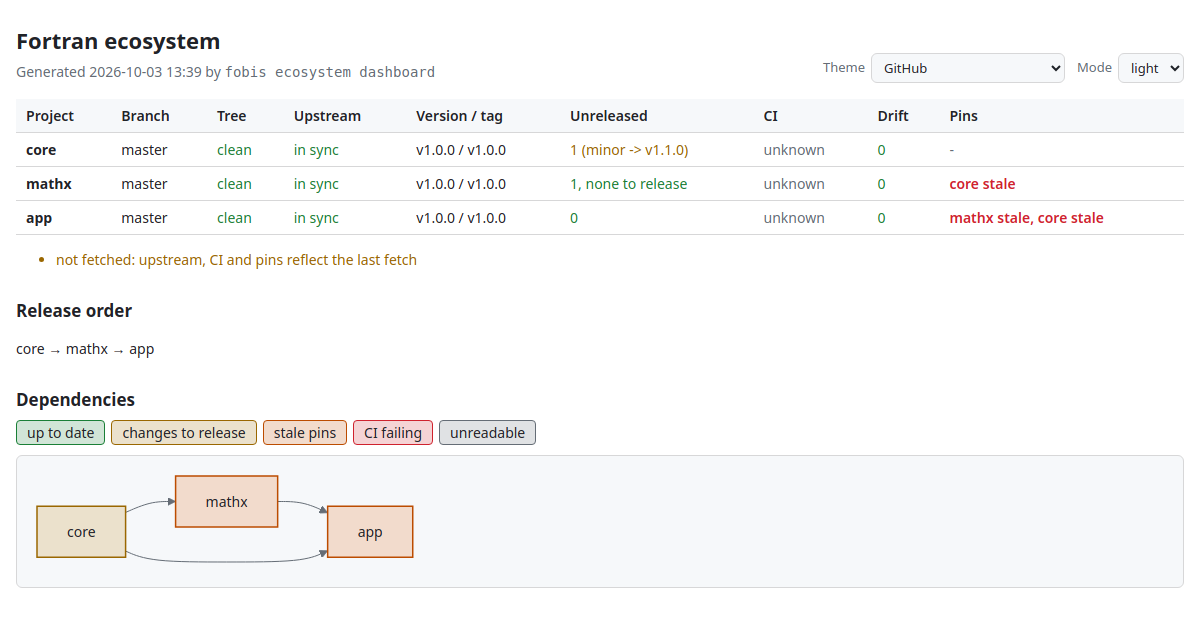
A self-contained HTML page: the same table with links to each repository, its Actions and its releases, the release order, and the dependency diagram with every node coloured by its project's state.
$ fobis ecosystem dashboard --no-ci --format html --no-open -o dashboard.html && ls -s --block-size=K dashboard.html
Dashboard written to ~/eco/dashboard.html
16K dashboard.html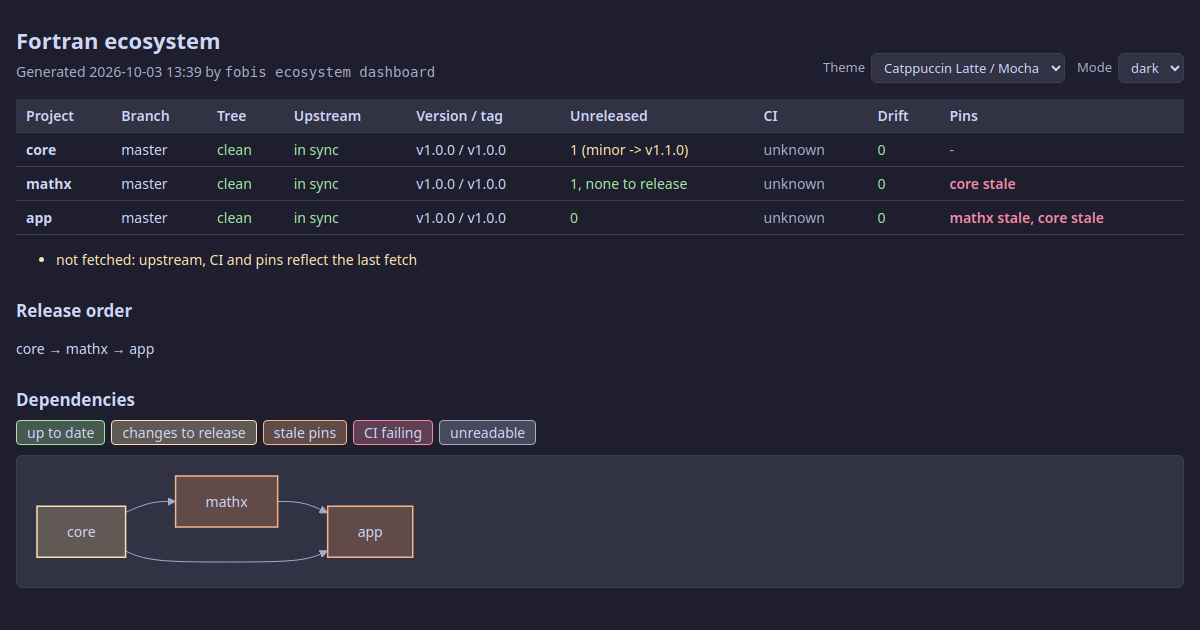
fobis ecosystem dashboard --format html                       # ~/.cache/fobis/ecosystem.html, opened in the browser
fobis ecosystem dashboard --format html --theme nord --mode dark
The page has Theme and Mode selectors that switch live and are remembered by the browser. Nine palettes, each with a light and a dark variant: github (the default), solarized, dracula (Alucard / Dracula), nord (Snow Storm / Nord), tokyo-night, catppuccin (Latte / Mocha), gruvbox, one, rose-pine (Dawn / Rosé Pine). The mode is auto (follow the system, live), light or dark. Set your defaults in the user configuration:
[ecosystem]
theme = catppuccin
mode = auto- Contrast is enforced: secondary, link and status text is darkened or lightened, keeping its hue, to a 4.5:1 contrast with the background.
- Offline: the diagram is drawn by Mermaid from a CDN; without network the page shows the table and the diagram source. Without JavaScript it falls back to the GitHub palette.
XDG_CACHE_HOMEmoves the default page;-o FILEwrites elsewhere,--no-opendoes not start a browser.- An unknown theme or mode exits 2 (checked only when a page is written).
- On WSL a Windows browser cannot open a
file:///home/...path: write the page, then open it from Windows.
fobis ecosystem dashboard --format html --no-open
explorer.exe "$(wslpath -w ~/.cache/fobis/ecosystem.html)"
Run a command in every project
exec runs a command in each project's directory through bash -c, in release order, its output streaming live under a ==> PROJECT: command header, then sums up:
$ fobis ecosystem exec -- git log --oneline -1

==> core: git log --oneline -1
c3b0b47 feat(core): add halve()

==> mathx: git log --oneline -1
fae4cf3 docs: explain quadruple()

==> app: git log --oneline -1
48ded4b feat(app): first release

Project  Result        Time  Detail
core     passed        0.0s
mathx    passed        0.0s
app      passed        0.0s

3 passed, 0 failed$ fobis ecosystem exec -- fobis build --quiet
==> core: fobis build --quiet
Building src/test_core.f90
Compiling src/core_m.f90 serially
Compiling src/test_core.f90 serially
Linking build/test_core
Target src/test_core.f90 has been successfully built
==> mathx: fobis build --quiet
Building src/test_mathx.f90
Compiling third_party/core/src/core_m.f90 serially
Compiling src/mathx_m.f90 serially
Compiling src/test_mathx.f90 serially
Linking build/test_mathx
Target src/test_mathx.f90 has been successfully built
==> app: fobis build --quiet
Building src/app.f90
Compiling third_party/core/src/core_m.f90 serially
Compiling third_party/mathx/src/mathx_m.f90 serially
Compiling src/app.f90 serially
Linking build/app
Target src/app.f90 has been successfully built
Project Result Time Detail
core passed 0.2s
mathx passed 0.2s
app passed 0.2s
3 passed, 0 failedfobis ecosystem exec -- git status -s # several words form one command
fobis ecosystem exec -- 'fobis clean && fobis build' # one argument is a shell command line
fobis ecosystem exec --only core,mathx --fail-fast -- fobis test
fobis ecosystem exec --from mathx -- fobis test # resume after a failure| Result | Meaning |
|---|---|
passed | the command succeeded |
failed | non-zero exit |
crashed | killed by a signal (the detail names it, e.g. SIGSEGV) |
aborted | a release declined at its prompt (release only) |
skipped | not run: unreadable project, nothing to do, a dependency not fetched |
not run | after a failure, with --fail-fast (and always in release) |
fobismeans this FoBiS.fobisandFoBiS.pyin the command, and in the fobos rules it runs, resolve to the FoBiS runningexec, not to whichever one the PATH finds first.- Exit codes: 1 when a project failed or crashed; 2 without a command or for an unknown project name.
--onlykeeps the release order whatever order you list the names in. - Clean builds everywhere. FoBiS skips up-to-date objects, so an object built with other flags can survive a flag change:
fobis ecosystem exec -- 'fobis clean && fobis build'rules that out.
Bring every dependency to its head
fetch runs fobis fetch --update in every project with dependencies, dependencies first, so each lock ends at the current heads and the Pins column turns current:
$ fobis ecosystem fetch

==> mathx: fobis fetch --update
Updating core
Saved deps config to third_party/.deps_config.ini
Saved lock file to third_party/fobos.lock

==> app: fobis fetch --update
Updating mathx
Updating core
Saved deps config to third_party/.deps_config.ini
Saved lock file to third_party/fobos.lock

Project  Result        Time  Detail
core     skipped             no dependencies
mathx    passed        0.2s
app      passed        0.2s

2 passed, 0 failed
It takes --only, --from and --fail-fast like exec; a project with no dependency is skipped. More on [dependencies] and the lock file in Dependencies.
Check the dependents before releasing
The question before releasing a library is not whether it passes its own tests (its CI answers that) but whether it breaks the projects that use it. check answers it with your local working copy, uncommitted changes included, without touching any repository:
$ fobis ecosystem check core
Checking mathx, app against the local working copy of core

==> mathx: (fobis build --quiet) && (./build/test_mathx)

Building src/test_mathx.f90
Compiling third_party/core/src/core_m.f90 serially
Compiling src/mathx_m.f90 serially
Compiling src/test_mathx.f90 serially
Linking build/test_mathx
Target src/test_mathx.f90 has been successfully built
mathx: all tests passed

==> app: (fobis build --quiet) && (./build/app)

Building src/app.f90
Compiling third_party/core/src/core_m.f90 serially
Compiling third_party/mathx/src/mathx_m.f90 serially
Compiling src/app.f90 serially
Linking build/app
Target src/app.f90 has been successfully built
twice(3) =  6.0   quadruple(3) = 12.0

Project  Result        Time  Detail
mathx    passed        0.2s
app      passed        0.3s

2 passed, 0 failed
For every project depending on the checked one, directly or transitively, in release order:
- its working copy (tracked and untracked files; ignored files such as build products and fetched dependencies excluded) is copied to a temporary directory;
- its fetched dependencies are copied into the copy's
deps_diras it fetched them, with.deps_config.iniandfobos.lock, except the checked project, taken from its working copy; apath=dependency is copied to the same relative place; - its check commands run there, chained with
&&, from scratch: no stale object leaks into the result.
The commands come from the dependent's fobos: [ecosystem] check, one command per line; else fobis rule --ex makecoverage when the fobos has a [rule-makecoverage] (what the CI runs); else fobis build.
[ecosystem]
check = fobis build --mode tests-gnu
        ./scripts/run_tests.sh
A change that breaks a dependent, twice renamed double in core and not committed:
$ fobis ecosystem check core
Checking mathx, app against the local working copy of core

==> mathx: (fobis build --quiet) && (./build/test_mathx)

Building src/test_mathx.f90
Compiling third_party/core/src/core_m.f90 serially
Compiling src/mathx_m.f90 serially
src/mathx_m.f90:2:19:

    2 |   use core_m, only: twice
      |                   1
Error: Symbol 'twice' referenced at (1) not found in module 'core_m'
src/mathx_m.f90:10:14:

   10 |     y = twice(twice(x))
      |              1
Error: Function 'twice' at (1) has no IMPLICIT type
src/mathx_m.f90:10:14:

   10 |     y = twice(twice(x))
      |              1
Error: Reference to impure function 'twice' at (1) within a PURE procedure


==> app: (fobis build --quiet) && (./build/app)

Building src/app.f90
Compiling third_party/core/src/core_m.f90 serially
Compiling third_party/mathx/src/mathx_m.f90 serially
third_party/mathx/src/mathx_m.f90:2:19:

    2 |   use core_m, only: twice
      |                   1
Error: Symbol 'twice' referenced at (1) not found in module 'core_m'
third_party/mathx/src/mathx_m.f90:10:14:

   10 |     y = twice(twice(x))
      |              1
Error: Function 'twice' at (1) has no IMPLICIT type
third_party/mathx/src/mathx_m.f90:10:14:

   10 |     y = twice(twice(x))
      |              1
Error: Reference to impure function 'twice' at (1) within a PURE procedure


Staged copies kept in ~/tmp/fobis-check-core-lsrgeosw

Project  Result        Time  Detail
mathx    failed        0.2s  exit 1
app      failed        0.2s  exit 1

0 passed, 2 failed: mathx, app
[exit status 1]fobis ecosystem check core --keep # keep the staged copies even when everything passes
fobis ecosystem check core --fail-fast # stop at the first failing dependent- The staged copies are removed after a full pass and kept, their path printed, when a check does not pass.
skipped: dependency X not fetched: the dependent never ranfobis fetch; runfobis ecosystem fetch.- Exit 1 unless every dependent passed,
skippedones included; 2 for an unknown project. A project nothing depends on has nothing to check (exit 0).
What an API change breaks
check builds the dependents; impact reads them. It compares the public interface of the project's Fortran modules between its latest tag (else HEAD) and its working tree, then finds every place in the dependents that uses what changed, without building anything:
$ git -C core diff --stat
 src/core_m.f90    | 6 +++---
 src/test_core.f90 | 4 ++--
2 files changed, 5 insertions(+), 5 deletions(-)$ fobis ecosystem impact core
core: public API changes since v1.0.0
added procedure core_m::double (src/core_m.f90:6)
added procedure core_m::halve (src/core_m.f90:12)
BREAKING removed procedure core_m::twice (src/core_m.f90:6)
mathx: affected
src/mathx_m.f90:2: use core_m, only: twice [changed: twice]
src/mathx_m.f90:10: twice: y = twice(twice(x))
app: affected
src/app.f90:2: use core_m, only: twice [changed: twice]
src/app.f90:5: twice: print '(A,F5.1,A,F5.1)', "twice(3) =", twice(3.0), " quadruple(3) =", quadruple(3.0)
1 breaking change(s); 2 of 2 dependent project(s) affected.
[exit status 1]fobis ecosystem impact core # since the latest tag
fobis ecosystem impact core --base v1.0.0 # since another revision
fobis ecosystem impact core --format markdown # for a release note or an issue
fobis ecosystem impact core --format json- The public interface of a module: its public procedures with their signature (prefixes, dummy arguments and their declarations, function result), generic interfaces and their specifics, derived types and their components, variables, and named constants with their value (a kind constant that changes is an interface change). Default access and access lists (
public :: str, strz) are honoured. - Breaking is a removed or changed entity, or a removed module; an added one is listed, not breaking. When nothing breaks, the dependents are not scanned.
- Re-exports: a facade module that
uses a changed module and makes the changed name public changes too, transitively (PENF'spenfre-exportspenf_global_parameters_variables, and dependents onlyuse penf). - A dependent is affected when its code references a changed name (
onlylists and renames resolved), when anonlylist imports a removed name, or when it uses a removed module. A plainusethat never references what changed is not affected. - Only the dependent's own files are read (
git ls-files, tracked and untracked): fetched dependencies and the contents of git submodules (vendored copies) are not its code. - Exit 1 when a dependent is affected; 2 for an unknown project or format.
--deepadds a model summary for the release train (what breaks, what to do), cited on these facts;--deep-contextprints its input and runs no model. See AI assistance.
Shared boilerplate in one project
fobis scaffold keeps the boilerplate of a project identical to the templates bundled in FoBiS, with the project's name and URLs filled in: no template repository, no extra tool.
$ cd mathx && fobis scaffold status
  OUTDATED .github/workflows/ci.yml
  OK       .github/workflows/docs.yml
  OK       .github/workflows/install.yml
  OK       .github/actions/setup-build-env/action.yml
  OK       .github/actions/run-coverage-analysis/action.yml
  SKIPPED  scripts/release.sh (project-owned: fobos [scaffold] skip)
  OK       scripts/run_tests.sh
  OK       scripts/install.sh
  OK       scripts/compute-coverage.sh
  OK       docs/package.json
  OK       cliff.toml
  OK       docs/guide/contributing.md
  OK       CONTRIBUTING.md
  OK       LICENSE.gpl3.md
  OK       .github/workflows/release.yml
  OK       docs/.vitepress/config.mts
  OK       docs/ford.md
  OK       fpm.toml
OK fobosfobis scaffold status # every managed file and its state
fobis scaffold status --files "scripts/*" # a glob of managed paths (* also matches /)
fobis scaffold status --strict # exit 1 on any drift: a CI check
fobis scaffold sync # each difference as a diff, then [Y/n] per file
fobis scaffold sync --dry-run # the diffs, nothing written
fobis scaffold sync --files cliff.toml --yes
fobis scaffold init # create every missing managed file
fobis scaffold list # the managed files by category$ cd mathx && fobis scaffold sync --yes && git status --short
--- .github/workflows/ci.yml ---
--- a/.github/workflows/ci.yml
+++ b/.github/workflows/ci.yml
@@ -27,4 +27,3 @@
- name: Run tests with coverage
id: cov
uses: ./.github/actions/run-coverage-analysis
-# local edit
Written .github/workflows/ci.yml
1 file(s) updated.| State | Meaning |
|---|---|
OK | identical to the template (an init-only file: present) |
OUTDATED | differs from the (rendered) template: sync overwrites it |
MISSING | absent: sync (or init) creates it |
SKIPPED | project-owned through [scaffold] skip: never written, not drift |
SYMLINK | CONTRIBUTING.md is not a link to its target: sync makes it one |
PATCH | a required configuration fragment is missing: sync inserts it |
MANUAL | the fragment cannot be inserted unambiguously: sync prints it for you to add |
UNRENDERED | a project-owned file still holds init |
- No consent, no write.
syncasks per file (Enter means yes); when no answer is possible (no terminal, stdin at end of file, CI, a pipe) the answer is no. Unattended runs need--yes. initcreatessrc/,docs/,.github/workflows/,.github/actions/andscripts/, then every missing managed file; an existing file is left alone (exists). It asks for the project variables it cannot resolve;--yesasks nothing and leaves them empty.- Plain
statusexits 0 whatever drifts; only--strictturns drift into exit 1. Pin the FoBiS version in that CI job: a FoBiS upgrade with new templates is drift. - Stateless: drift is the SHA-256 of the file against the SHA-256 of the rendered template, nothing recorded. Files outside the manifest are never touched.
- A file it cannot write (permissions) stops the command with Python's
PermissionError. - Then commit by hand:
git add -A && git commit -m "chore: sync scaffold boilerplate".
New project from scratch: fobis new (in Building) writes a fobos and sources, and fobis new --scaffold adds this boilerplate.
What scaffold manages
| Category | Files | sync |
|---|---|---|
| verbatim | .github/workflows/ci.yml, docs.yml, install.yml, .github/actions/run-coverage-analysis/action.yml, scripts/release.sh, scripts/run_tests.sh, scripts/install.sh, scripts/compute-coverage.sh, docs/package.json, cliff.toml, LICENSE.gpl3.md | overwrites |
| templated | .github/workflows/release.yml (.github/actions/setup-build-env/action.yml ( | overwrites with the rendered text |
| init-only | fobos, fpm.toml, docs/ford.md (rendered when created), docs/guide/contributing.md | never: yours after init |
| patched | docs/.vitepress/config.mts (rendered when created) | only inserts the build: { target: 'es2022' } block into vite: { |
| symlink | CONTRIBUTING.md -> docs/guide/contributing.md | creates or repairs the link, never writes through it |
What the files do: ci.yml builds and tests; docs.yml deploys the VitePress site and the coverage badge; release.yml publishes the release notes when a tag is pushed; install.yml smoke-tests the install methods the project has (make, CMake, FoBiS, fpm) after a release. scripts/release.sh vX.Y.Z (or --patch/--minor/--major) regenerates CHANGELOG.md with git-cliff, updates VERSION (and the fpm.toml version), commits, tags and pushes. scripts/run_tests.sh runs the tests serially, --np N under MPI, --vmem KB capping each test's memory; a test with a <name>.result file (the doctests) must print that result.
The variables come from the fobos [project] section, then from git:
| Variable | fobos [project] key | Fallback |
|---|---|---|
| name | the repository name |
| summary | empty |
| repository | git remote get-url origin (SSH turned into HTTPS) |
| (derived) | the last path segment of |
| website | empty |
| authors, one per line, joined with , | git config user.name |
| email | git config user.email |
| year (pin the founding year) | the current year |
| [dependencies], written as fpm dependencies | the git submodules |
[project]
name       = PENF
summary    = Portability Environment for Fortran
version    = VERSION
repository = https://github.com/szaghi/PENF
website    = https://szaghi.github.io/PENF
email      = stefano.zaghi@cnr.it
year       = 2015
authors    = Stefano Zaghi
             Jane Doe
The [scaffold] section holds the project's own knobs; without it every file renders to the defaults:
[scaffold]
; extra system packages for the CI build environment, appended to its apt install line
apt_packages = libopenmpi-dev openmpi-bin zlib1g-dev
; managed files this project owns (globs): reported SKIPPED, never written by sync or init
skip = scripts/release.shskipis for a deliberate customisation (arelease.shthat also bumps a CMake version): the file stays out ofstatus --strict,sync,init, the dashboard's Drift column andfobis ecosystem scaffold.- MPI in CI: the packages go in
apt_packages; running the tests undermpirunisscripts/run_tests.sh --np N. - Old layouts are replaced: a
run-coverageaction, aninstall.shor acliff.tomlhardcoding the repository, arelease.ymlthat also deployed the docs are allOUTDATED, andsyncwrites the current files.
Shared boilerplate across the projects
The same states for every registered project, honouring each one's skip:
$ fobis ecosystem scaffold status
core: in sync
  SKIPPED  scripts/release.sh (project-owned)
mathx: in sync
  SKIPPED  scripts/release.sh (project-owned)
app: in sync
SKIPPED scripts/release.sh (project-owned)$ fobis ecosystem scaffold status
core: in sync
SKIPPED scripts/release.sh (project-owned)
mathx: 1 not in sync
OUTDATED .github/workflows/ci.yml
SKIPPED scripts/release.sh (project-owned)
app: in sync
SKIPPED scripts/release.sh (project-owned)
[exit status 1]fobis ecosystem scaffold status # exit 1 when any project drifts
fobis ecosystem scaffold status --only PENF,FACE --files ".github/*"
fobis ecosystem scaffold sync # the diffs, project by project: writes nothing
fobis ecosystem scaffold sync --apply # confirm each project (default no), then write
fobis ecosystem scaffold sync --files "scripts/*" --apply --yes--applywithout a terminal writes nothing and exits 1: add--yesfor an unattended run.- After upgrading FoBiS the new templates show as drift:
pip install -U FoBiS.py, thenscaffold status,scaffold syncto review,scaffold sync --apply, andfobis ecosystem exec -- git status -sbefore committing in each repository.
The release train
Releasing a family by hand means: release the bottom library, wait for it, update its dependents' locks, release them, and so on up the graph. release plans the whole train first:
$ fobis ecosystem release --dry-run --no-wait
Release plan (dependencies first)
   1. core  v1.0.0 -> v1.1.0        ready  (minor, 1 releasable commit(s))
        ! CI at HEAD: unknown
        ! not on GitHub: the GitHub release cannot be awaited

Dry run: nothing released.
The plan. After a
git fetchand a CI query, every project with releasable commits, in release order, with the version its commits call for, computed from its latest tag.--bump NAME=major|minor|patchor--bump NAME=vX.Y.Zoverrides one (repeatable) and brings into the plan a project with nothing releasable.Pre-flight, for every project before anything runs. One blocker refuses the whole train, so no ecosystem is left half released:
Blocks the train Only warns no executable scripts/release.shunpushed commits (CI has not seen them) git-cliffnot on the PATHCI running,noneorunknownnot on the trunk (the remote default branch) not fetched ( --no-fetch)uncommitted changes not on GitHub (the release cannot be awaited) behind the upstream, or no upstream CI failing at HEAD no previous tag and no explicit version version not above the current tag, or already tagged an unreadable project Confirmation of the plan as a whole (default no).
For each project:
scripts/release.sh vX.Y.Zwith the planned version, so the version you approved is the one tagged; it runs with your terminal's stdin and asks its own confirmation. Then the tag must exist locally and on the remote; the GitHub release is awaited (gh release view,--timeout, default 900 s); andfobis fetch --updateruns in its direct dependents, so the next projects release against the new version.Stop at the first failure, the rest
not run, printing the command that resumes the train:Stopped at FLAP. Fix it, then resume with:followed byfobis ecosystem release --from FLAP, with your--bumpoverrides repeated.
$ fobis ecosystem release --yes --no-wait
Release plan (dependencies first)
   1. core  v1.0.0 -> v1.1.0        ready  (minor, 1 releasable commit(s))
        ! CI at HEAD: unknown
        ! not on GitHub: the GitHub release cannot be awaited

==> core: ./scripts/release.sh v1.1.0
  Current version : v1.0.0
  New version     : v1.1.0
Released v1.1.0!

==> mathx: fobis fetch --update
Updating core
Saved deps config to third_party/.deps_config.ini
Saved lock file to third_party/fobos.lock

==> app: fobis fetch --update
Updating mathx
Updating core
Saved deps config to third_party/.deps_config.ini
Saved lock file to third_party/fobos.lock

Project  Result        Time  Detail
core     passed        0.0s  v1.1.0 pushed (GitHub release not awaited)

1 passed, 0 failed$ fobis ecosystem dashboard --no-ci
Project Branch Tree Upstream Version / tag Unreleased CI Drift Pins
------- ------ ----- -------- --------------- ------------------ ------- ----- -------
core master clean in sync v1.1.0 / v1.1.0 0 unknown 0 -
mathx master clean in sync v1.0.0 / v1.0.0 1, none to release unknown 0 current
app master clean in sync v1.0.0 / v1.0.0 0 unknown 0 currentfobis ecosystem release --dry-run # the plan and its blockers, nothing else
fobis ecosystem release # the train
fobis ecosystem release --only core,mathx --bump core=v2.0.0
fobis ecosystem release --no-wait # do not wait for the GitHub releases- A declined prompt is no release.
release.shexits 0 when you answer no; the missing tag reports itaborted. Nothing was pushed: re-run the train. - Resuming never releases twice: a released project's new tag leaves it nothing to release, so it drops out.
--yesapproves the plan and answers everyrelease.shprompt. Use it only for an unattended run of a plan reviewed with--dry-run.- The release is awaited only on GitHub with
ghon the PATH; otherwise the result readsvX.Y.Z pushed (GitHub release not awaited). A release not published within the timeout, or a failed fetch in a dependent, fails the project. - Your own
release.shworks if it takes the version as its only argument, tags and pushes;git-cliffis required anyway (pipx install git-cliff), as the scaffolded script needs it. - Exit codes: 0 when every planned project is released, nothing needs a release, the plan is declined, or a
--dry-runfinds no blocker; 1 when a project is blocked, the confirmation cannot be answered, or a release fails, aborts or is not published in time; 2 for an invalid--bumpor an unknown project.
What calls for a release
Whether a project needs a release is decided by the files its commits change; how big a release by their Conventional Commits type:
- A commit since the latest tag is releasable when it changes at least one file outside the excluded globs, by default
docs/* .github/* *.md scripts/*(fnmatch on repository-relative paths,*also matching/). A docs-only or CI-only commit is unreleased but calls for no release, whatever its type; a commit changing no file (a merge, an empty commit) does not count. - The bump comes from the releasable commits only: a
!after the type or scope, or aBREAKING CHANGEfooter, means major;featmeans minor; anything else, a non-conventional message included, means patch.
| Commit | Files changed | Releasable | Bump |
|---|---|---|---|
fix(docs): target es2022 | docs/package.json, scripts/release.sh | no | |
build(fpm): track default branches | fpm.toml | yes | patch |
feat(core): add halve() | src/core_m.f90 | yes | minor |
refactor(api)!: rename twice | src/core_m.f90 | yes | major |
Commit types are written by hand and are sometimes wrong; the files a commit touches are not. A project replaces the globs in its own fobos (the dashboard and release both read them):
[ecosystem]
release_exclude = docs/* .github/* *.md scripts/* examples/*
A change at the bottom of the stack
# edit PENF, do not commit yet
fobis ecosystem impact PENF                 # which dependents use what changed, file by file
fobis ecosystem check PENF                  # do they still build and pass against the working copy?
git -C ~/fortran/PENF commit -am "feat(io): ..." && git -C ~/fortran/PENF push
fobis ecosystem release --dry-run           # PENF, and anything else that needs a release
fobis ecosystem release
A morning look at the family is fobis ecosystem dashboard (what changed, what is red, what is stale), then fobis ecosystem fetch to bring every pin to the current heads.
In CI or a cron job
fobis ecosystem dashboard --json > ecosystem.json
fobis ecosystem scaffold status             # exit 1 on drift
fobis ecosystem release --dry-run           # exit 1 when a planned release is blocked
More in Continuous integration.
Try it offline
The documentation ships a script that builds a small private ecosystem: three Fortran projects (core <- mathx <- app, and app also uses core), each a clone of a local bare remote, with history, a v1.0.0 tag, fetched dependencies in third_party/, the scaffold boilerplate, a minimal scripts/release.sh, and commits after the tag (core a releasable feat, mathx a docs commit, app nothing). Nothing leaves the directory you give it, so you can release, break and repair at will:
bash docs/demo/ecosystem-demo/setup.sh ~/eco    # the script is in the FoBiS repository
source ~/eco/env.sh                             # the demo registry; its github.com/demo URLs resolve locally
cd ~/eco
fobis ecosystem graph
fobis ecosystem dashboard --no-ci
fobis ecosystem check core
fobis ecosystem release --dry-run$ ls
app
core
env.sh
mathx
remotes$ cat app/fobos | sed -n "/dependencies/,/^$/p"
[dependencies]
deps_dir = third_party
mathx = https://github.com/demo/mathx
core = https://github.com/demo/coreenv.sh sets XDG_CONFIG_HOME to the demo's own configuration, so your registry is never touched, and rewrites https://github.com/demo/ to the local remotes with git's url.<base>.insteadOf, so fetch and release work without network. It needs git and gfortran, and git-cliff for the release pre-flight. Every output on this page and every GIF was recorded on it. Delete the directory to remove it.
Configuration at a glance
In the user configuration (~/.config/fobis/config.ini):
[ecosystem]
root     = ~/fortran
projects = PENF FACE BeFoR64 StringiFor
           FLAP
theme    = github
mode     = auto
In each project's fobos:
[ecosystem]
; the commands of fobis ecosystem check, one per line
check           = fobis build --mode tests-gnu
                  ./scripts/run_tests.sh
; changes that call for no release
release_exclude = docs/* .github/* *.md scripts/*

[scaffold]
apt_packages = libopenmpi-dev
skip         = scripts/release.sh
The [project] keys feed the templates (above) and version, the dashboard's Version column; the [dependencies] section is the graph (Dependencies).