

C1 Rows by their meaning
| ID | Group | Type | Backends | Figure | Program |
|---|---|---|---|---|---|
| C1 | Contracts | C | Python 3 (exact rationals, 100-digit decimals) | yes | scripts/gen_gideon.py --check |
Case and scope
Every coefficient of GIDEON is derived by the generator from what the row means, a datum (a point value or a cell average) and a target (a derivative at a point, or its average over a cell), never copied from a table. This case is the generator's own checks, run before any Fortran is written: a row that fails one of them is not emitted, and the generator exits 1. What it cannot check, the compiled kernels, is the subject of C2 to C6.
Models and numerics
| Item | Choice | Code |
|---|---|---|
| Derivation | the moment system fractions.Fraction | derive |
| Exact degree, order | the largest | exact_degree, composite_order |
| Pair form | a centred row is symmetric or antisymmetric, exactly, or the generator stops | check_pairs |
| Mirrors | every left-side row solved independently on its own window, and compared with the right-side row mirrored, times | build |
| ADAM | ADAM's committed tables (notes/adam-reference/) parsed into exact fractions and compared with the derived rows, never adopted | parse_adam_tables, cross_check_adam |
| Orders, free of round-off | check_orders | |
| Read-back | the emitted Fortran rows parsed back and compared with the derived ones | write_sources, parse_emitted_tables |
The figure shows four rows as the generator derives them: the weights by offset (exact), the window, the target.
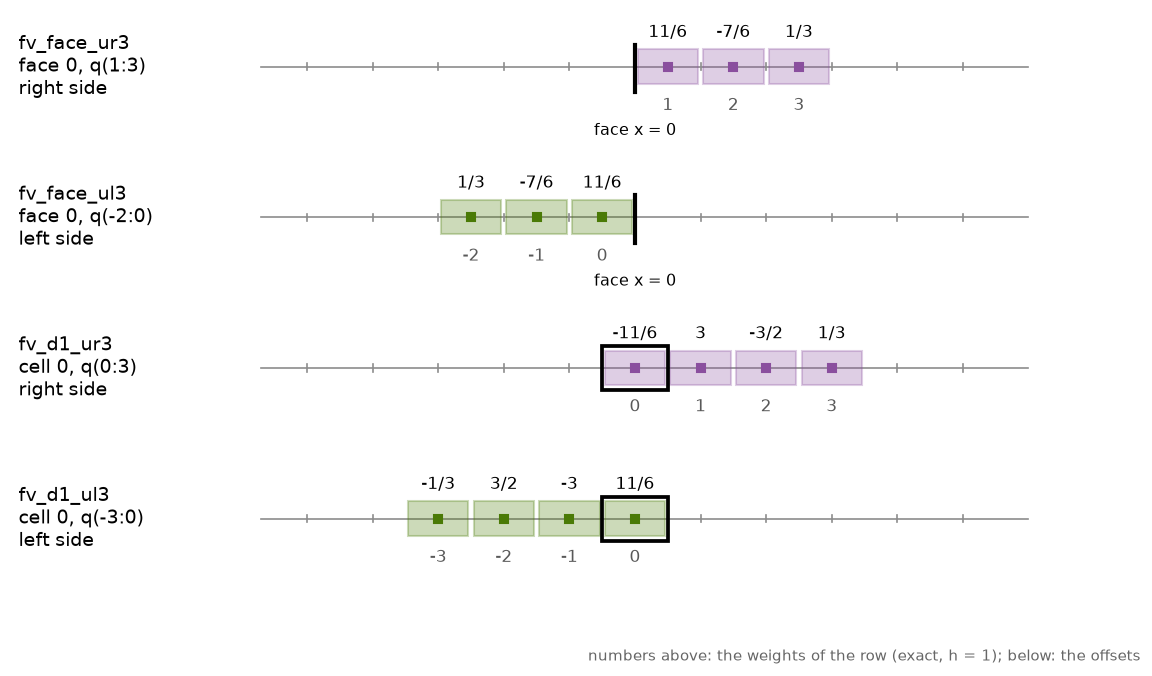
The right-side rows and their mirrors: face values (a face at 0) and cell-average first derivatives (cell 0). The left-side row is the right one read backwards, times
Program
python3 scripts/gen_gideon.py --check                    # derive and verify, write nothing
python3 scripts/gen_gideon.py --check --json rows.json   # the data of these pages (scripts/run_report.sh)
Results
| Check | Result |
|---|---|
| rows derived (exact rationals) | 332 |
| 3-D operators assembled from them | 40 |
| ADAM rows cross-checked (non-zero ones of its tables) | 93, mismatches 0 |
| left-side rows solved independently and found to be mirrors | 95 |
| orders at 100 digits ( | 332 rows, smallest margin -0.002 (fv_face_ur9, observed 8.998) |
| findings that fail the generator | 0 |
By family, with the smallest margin of the 100-digit order against the design order:
| Family | Kernels | Orders | Window (cells or nodes) | Smallest observed − design order (100 digits) |
|---|---|---|---|---|
| FD centred, face value | 5 | 2-10 | 2-10 | -0.000 (fd_face_c10) |
| FD centred, node derivatives d1-d6 | 24 | 2-10 | 3-11 | -0.000 (fd_d1_c10) |
| FD centred, face derivatives d1-d5 | 19 | 2-10 | 2-10 | -0.000 (fd_face_d2_c8) |
| FD one-sided, face value (extrapolation) | 18 | 1-9 | 1-9 | -0.002 (fd_face_ur9) |
| FD upwind-biased, face value (interpolation) | 8 | 3-9 | 3-9 | -0.000 (fd_face_br9) |
| FV centred, face value | 5 | 2-10 | 2-10 | -0.000 (fv_face_c10) |
| FV centred, face derivatives d1-d5 | 19 | 2-10 | 2-10 | -0.000 (fv_face_d2_c8) |
| FV centred, cell-average derivatives d1-d6 | 24 | 2-10 | 3-11 | -0.000 (fv_d1_c10) |
| FV upwind, face value | 18 | 1-9 | 1-9 | -0.002 (fv_face_ur9) |
| FV upwind, face derivatives d1-d5 | 60 | 1-8 | 2-9 | -0.002 (fv_face_d1_ur8) |
| FV upwind, cell-average derivatives d1-d6 | 78 | 1-9 | 2-10 | -0.002 (fv_d1_ur8) |
| Deconvolution (point value, cell average) | 10 | 4-12 | 3-11 | -0.000 (fv_point_c12) |
| FV upwind-biased, face value | 8 | 3-9 | 3-9 | -0.000 (fv_face_br9) |
| FD undivided face differences (dissipation fluxes) | 5 | 2-2 | 2-10 | -0.000 (fd_face_diss_c10) |
| FV undivided face differences (dissipation fluxes) | 5 | 2-2 | 2-10 | -0.000 (fv_face_diss_c10) |
| FD dissipation parts of the biased face values | 8 | 2-2 | 4-10 | -0.000 (fd_face_diss_br9) |
| FV dissipation parts of the biased face values | 8 | 2-2 | 4-10 | -0.000 (fv_face_diss_br9) |
| FD explicit filters | 5 | 2-10 | 3-11 | -0.000 (fd_filter_c10) |
| FV explicit filters | 5 | 2-10 | 3-11 | -0.000 (fv_filter_c10) |
| all | 332 |
Findings
- No mismatch with ADAM's tables: ADAM's coefficients are right where it has them. ADAM's defects (audit items A, B, F) are in how its kernels read the rows and their windows, not in the rows (C5).
- The upwind rows sit closest to the bound: at
their 100-digit orders are a few thousandths below the design order, the pre-asymptotic term of a one-sided stencil. The compiled kernels' orders, on coarser plateaus where quadruple precision resolves them, are in A1. - The FV centred cell-average derivatives have the rows of the FD node derivatives (below).
24 of the 24 centred cell-average derivatives fv_dN_cP have the weights of the node derivative fd_dN_cP of the same window, exactly (the rows of the JSON compared as fractions).
The reason: for a Fourier mode the cell average multiplies the data and the target by the same factor, fv) and by pairs (fd), so their values agree to round-off, not bitwise in general (A3 draws one curve for both).