

Verification
Every capability of GIDEON is backed by a verification case: a Fortran program in src/tests/ that runs the compiled kernels and asserts the result against something it shares no code with: the monomials a row must be exact on, a smooth function and its exact derivatives, a mirror or symmetry identity, ADAM's own code compiled verbatim, the host for the device. The generator adds a case of its own (C1): it checks the rows before any Fortran exists. The programs are the test suite (bash scripts/run_tests.sh), and with GIDEON_REPORT_DIR set they also write the data from which these pages are drawn (scripts/run_report.sh). Every table and figure of this section is generated from that data: rerun the script after any change of the generator or the kernels.
Each page has the same sections: case and scope, models and numerics with links to the code, the program and how to run it, results, findings. The tag of a card says what kind of check it is:
- contract: an identity that must hold exactly or within a stated tolerance: rows by their meaning, exactness, mirrors and symmetries, dispatch, equivalence with ADAM, host and device;
- accuracy: an order of accuracy, a convergence rate, a spectral property.
What a user of the kernels should know
The findings that change how the kernels are used, each documented on its page:
- The orders of every kernel are observed in quadruple precision only. In double precision the round-off floor hides the asymptotic range of the wide stencils; the R16P build resolves all of them (A1). The generator measures the rows themselves at 100 digits (C1).
- Only the one- and two-cell upwind first derivatives are stable advection operators on their own. From three cells on, every fully one-sided first derivative amplifies a band of wavenumbers of a wave moving towards it (A3). The wider rows are exact and kept as building blocks.
- A centred row does not dissipate. The pair form makes the imaginary part of the modified wavenumber zero to round-off, in the compiled kernels as in the rows (A3); a centred scheme needs its dissipation from elsewhere.
- The FV centred cell-average derivatives have the rows of the FD node derivatives of the same window, exactly: the averaging factor of a Fourier mode cancels. The kernels differ in arithmetic (a flux difference, a pair form), not in the operator (C1).
- ADAM's left-side upwind face value and first derivative are wrong for two or more cells, and ADAM's upwind names flip between the first derivative and the others; GIDEON fixes both and is bitwise equal to ADAM wherever ADAM is right (C5).
- A run-time order costs a
select caseper call, and an order without a kernel returns a NaN, never a number (C4). - An upwind-biased face value is the centred one plus one face difference, exactly: a sensor can dial the dissipation between the two. The one-sided values do not split this way (C7).
- The compact operators reach their orders on periodic lines, the centred ones without dissipation, the biased ones dissipative on their upwind side; the line solves are bitwise equal on the device (A4, C8).
- Rows replaced by given values keep the compact order away from them: the band's inverse decays geometrically (A5).
Contracts
What must hold exactly, or bit for bit: the rows, their compiled values, their identities, the dispatch, ADAM's values, the device.
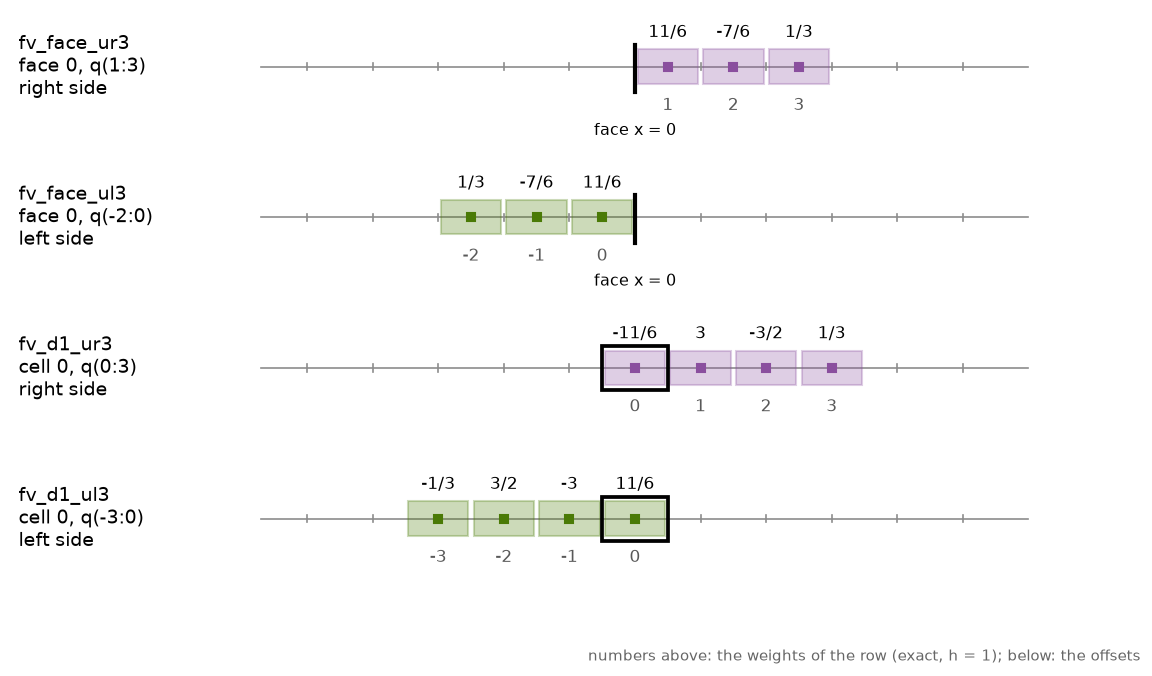 C1 Rows by their meaning
C4 Run-time dispatchevery dispatcher calls its kernel, bitwise; NaN for an order without onecontract
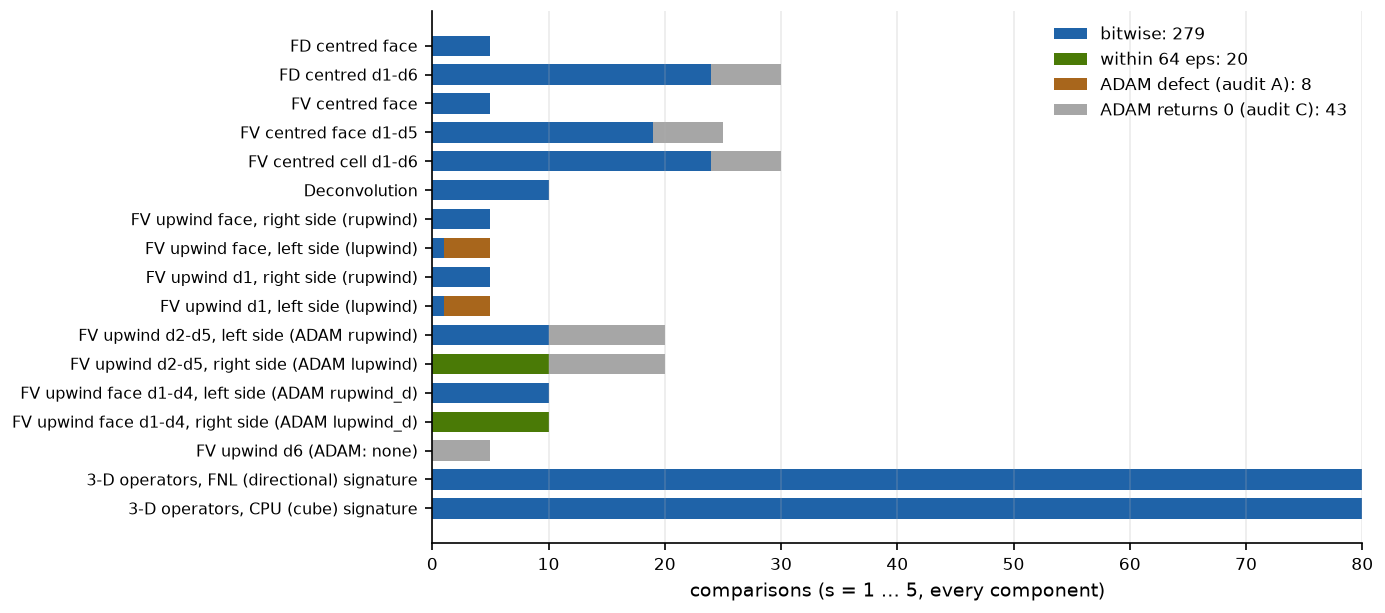 C5 Equivalence with ADAM
C6 Host and deviceevery kernel in an OpenACC loop on the GPU against the hostcontract
Accuracy
The design order of every kernel and every 3-D operator, and how the operators treat each Fourier mode.
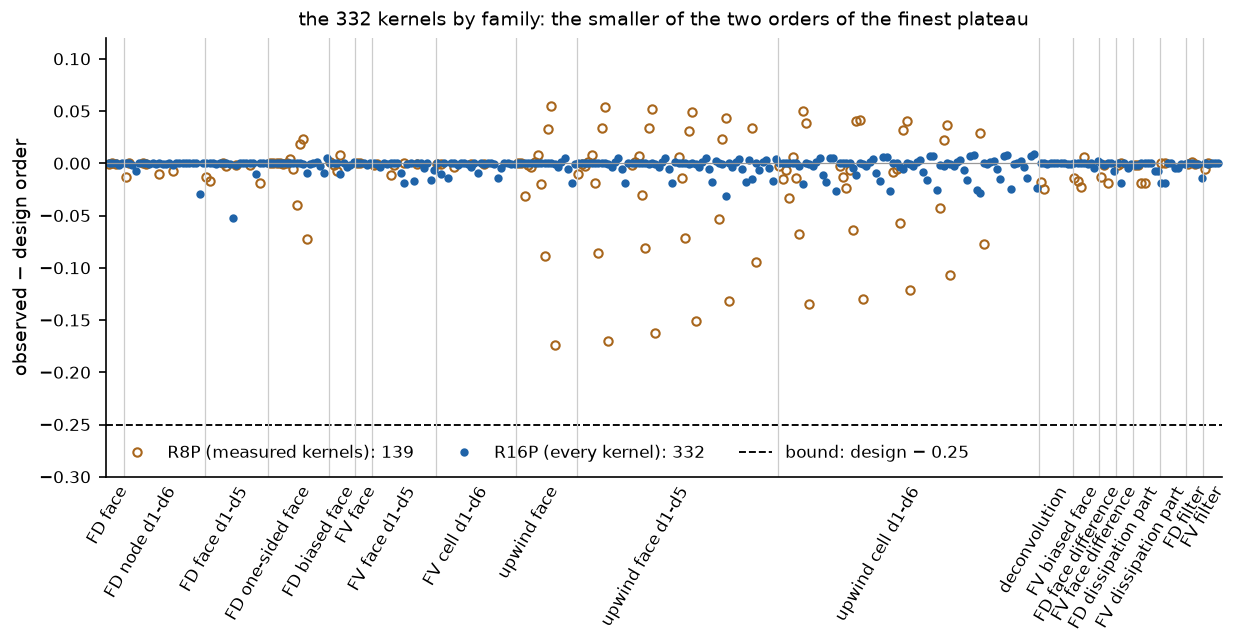 A1 Orders of accuracy
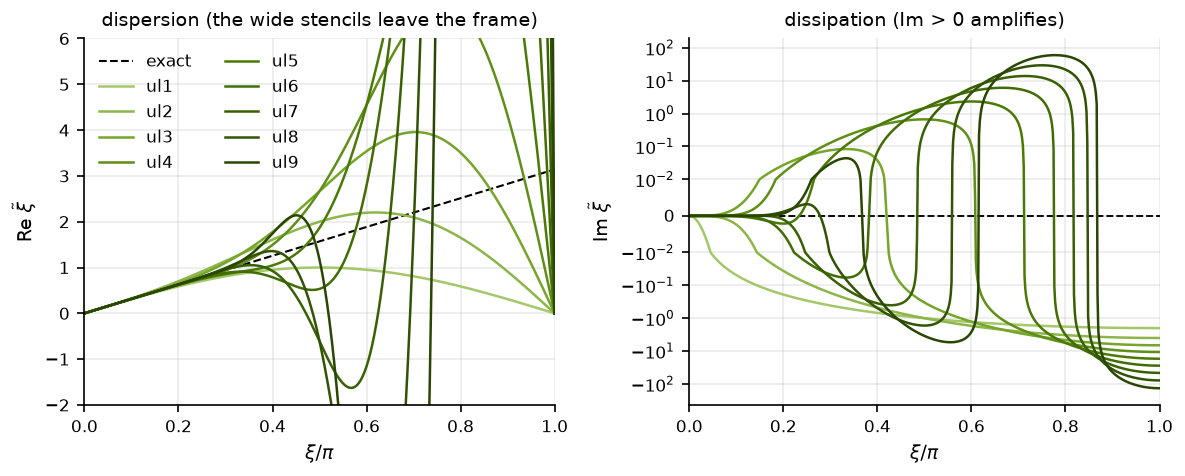 A3 Spectral properties
Regression
The values themselves, pinned by golden files, the suite's power to catch planted defects, and the CI that runs it all: Regression.
Running it
fobis build --mode tests-gnu && bash scripts/run_tests.sh   # the suite, double precision
fobis build --mode tests-gnu-r16 && bash scripts/run_tests.sh --exe-dir exe-r16   # the orders, quadruple precision
scripts/run_report.sh [--gpu]                                 # every build, the data, tables, figures, casts
python3 scripts/gen_gideon.py --check                         # C1: the rows, before any Fortran
The programs and the page of each:
| Program | Page | Builds |
|---|---|---|
scripts/gen_gideon.py --check | C1 Rows by their meaning | Python 3, exact rationals |
gideon_test_tables | C2 Exactness and leading error | every |
gideon_test_properties | C3 Mirrors and symmetries | every |
gideon_test_dispatch | C4 Run-time dispatch | every |
gideon_test_adam | C5 Equivalence with ADAM | R8P only |
gideon_test_device | C6 Host and device | every (on the device with OpenACC) |
gideon_test_order | A1 Orders of accuracy | every |
gideon_test_operators_3d | A2 3-D operators | every |
gideon_test_spectral, gideon_vv_advection | A3 Spectral properties | every |
scripts/gen_gideon.py --check, gideon_test_split | C7 The upwind–central split | Python 3; every |
gideon_test_solvers | C8 The line solvers | every (on the device with OpenACC) |
gideon_test_lines | A4 Compact operators | every (on the device with OpenACC) |
gideon_test_coupling | A5 Compact-WENO coupling | every (on the device with OpenACC) |
gideon_test_golden | Golden values | every (one golden file per kind) |
gideon_test_lines_golden | Golden values | every (the compact operators) |
gideon_test_kinds | the kinds reach a client through use gideon | every |
From the data to the pages
No number of this section is typed. scripts/run_report.sh builds the test programs (R8P, R16P, R4P, and with --gpu the OpenACC build), runs each with GIDEON_REPORT_DIR set so that it writes its data (CSV files, the frames of the advection), keeps every output, and then draws the pages from them with the scripts of docs/scripts:
| Script | Reads | Writes |
|---|---|---|
make_tables.py | the generator's JSON, the test outputs and CSV files, the golden files, the recorded mutation run (notes/mutation-run-*.txt), the benchmark data (notes/bench-data) | docs/verification/_tables, docs/regression/_tables |
make_figures.py | the same | every figure of docs/public/guide, docs/public/verification, docs/public/regression, light and dark |
make_animations.py | the frames of gideon_vv_advection | docs/public/verification/casts: WebM, MP4 and a poster per theme (needs ffmpeg) |
make_cookbook_tables.py | src/lib/*.F90 only (--check: exit 1 when a table is stale) | the tables of the cookbook and of the API overview (docs/ford.md) |
The figures share two modules: figure_theme.py, the light (washi) and dark (smoked bronze) styles, SETH's and ADAM's copy with GIDEON's dark tokens (its identity), which draws every figure a second time as <name>-dark.png for the dark theme; and gideon_palette.py, the grounds and the colours of the data. The Python needs numpy and matplotlib (GIDEON_DOCS_PYTHON, else exe/.docs-venv/bin/python, else python3).
What the pages say about the code is checked too: scripts/check_docs.py fails when a public entity, a module, a test program, an example, a fobos mode, a script or a figure is named on no page, when a page names a gideon_* procedure or an ADAM routine that does not exist, or when an image, a link, an include or a snippet does not resolve. The code of the tutorials and the cookbook is compiled and run by scripts/run_examples.sh, each output compared with the one the page shows.