

Performance
Program src/bench/gideon_bench_adam.F90 (modes bench-nvf-oac, bench-nvf, bench-gnu), raw outputs in notes/bench-data/. Method (SETH's): N = 2^24 points of a 1-D array, one kernel at every point inside one loop (!$acc parallel loop on the GPU, a plain loop on one CPU core pinned with taskset -c 2), 2 warm-up passes, the median of 20 timed passes (system_clock around the loop, !$acc wait), four runs of the program for the spread. ADAM's operators are compiled verbatim (ff879596) in the same build.
Hardware: NVIDIA GeForce RTX 4070 (GPU1, driver 610.88), nvfortran 26.9 -acc -gpu=cc89; Intel Core i9-13900KF, one core, gfortran 16.2 -O3 and nvfortran 26.9 (FoBiS release profiles). The RTX 4070 runs FP64 at 1/64 of its FP32 rate: a ratio measured here is not a claim about a data-centre GPU (PERF5), where these kernels are bound by memory, not by FP64 throughput.
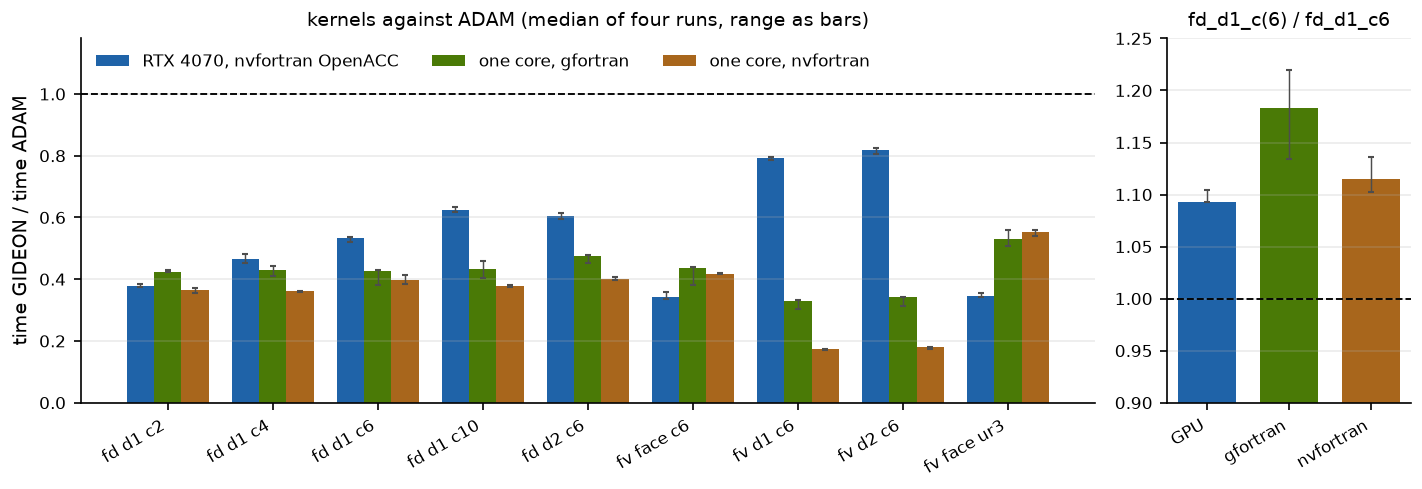
Ratio GIDEON / ADAM (median of the four runs' medians; range in brackets)
| Case | RTX 4070 | one core, gfortran | one core, nvfortran |
|---|---|---|---|
| fd d1 c2 | 0.380 (0.375–0.384) | 0.423 (0.423–0.430) | 0.363 (0.355–0.373) |
| fd d1 c4 | 0.465 (0.452–0.482) | 0.428 (0.409–0.442) | 0.361 (0.359–0.363) |
| fd d1 c6 | 0.532 (0.522–0.538) | 0.425 (0.381–0.431) | 0.397 (0.385–0.415) |
| fd d1 c10 | 0.625 (0.617–0.633) | 0.433 (0.405–0.458) | 0.379 (0.374–0.382) |
| fd d2 c6 | 0.605 (0.595–0.615) | 0.475 (0.452–0.479) | 0.401 (0.399–0.408) |
| fv face c6 | 0.344 (0.337–0.357) | 0.436 (0.381–0.438) | 0.417 (0.416–0.421) |
| fv d1 c6 | 0.792 (0.785–0.797) | 0.331 (0.304–0.333) | 0.173 (0.171–0.174) |
| fv d2 c6 | 0.819 (0.807–0.825) | 0.342 (0.314–0.344) | 0.179 (0.173–0.182) |
| fv face ur3 | 0.345 (0.343–0.356) | 0.530 (0.509–0.558) | 0.553 (0.541–0.560) |
Absolute (run 1): on the GPU GIDEON 0.034–0.093 ns per point against ADAM's 0.099–0.128; on a gfortran core 0.94–1.53 against 1.82–4.87.
PERF1 (GIDEON <= 1.0 x ADAM): met, every case, every device. The gain is the compile-time row: ADAM's kernels read a (S_MAX, S_MAX) table (a device copy on the GPU) through a run-time s, with assumed-shape windows; GIDEON's rows are folded constants and the loops unrolled. The FV flux differences gain most on the CPU (0.17–0.34): ADAM calls the face reconstruction twice through the assumed-shape interface.
The run-time dispatcher: budget missed
gideon_fd_d1_c(6, ...) against gideon_fd_d1_c6: 1.093 (1.093–1.104) on the GPU, 1.183 (1.134–1.220) with gfortran, 1.115 (1.102–1.136) with nvfortran, against a budget of 1.05 set before coding. The select case is evaluated per call and is not hoisted out of the loop even with a loop-invariant order; on the CPU it also blocks the vectorisation of the loop. Recorded, not edited. What it means for a caller: an order known at compile time should call the kernel; a run-time order (PRISM's fdv_order) pays 9–22 % over the kernel, and still about 0.45–0.65 of ADAM's run-time-s path (1.093 x 0.532 on the GPU, 1.183 x 0.425 with gfortran). A faster dispatch would hoist the choice out of the loop: one loop per order in the caller, or a procedure pointer chosen once (not device code). Left to the owner. The first, as code: A run-time order, fast.
Compact operators: the band factored once, budget met
Program src/bench/gideon_bench_compact.F90 (modes bench-compact-nvf-oac, bench-compact-nvf, bench-compact-gnu), raw outputs notes/bench-data/compact-*. 2^24 points as 65536 periodic lines of 256, a line contiguous (q(i,l), the layout the line solvers take). The explicit operator and a compact right side: one kernel call per point; the solve: one line per call, one line per thread on the GPU. Same method and hardware as above. Budget, set before the program was written (roadmap #2, L6): gideon_fd_d1_p6 (right side + gideon_tri_periodic_const) <= 4 x gideon_fd_d1_c6 on one core, <= 8 x on the GPU.
| Ratio to the explicit operator of equal order (median of four; range) | one core, gfortran | one core, nvfortran | RTX 4070 |
|---|---|---|---|
fd_d1_p6, right side only | 0.93 (0.90–0.94) | 0.95 (0.87–0.96) | 0.88 (0.86–0.90) |
fd_d1_p6, solve only | 5.73 (5.55–5.77) | 6.25 (4.70–6.48) | 11.59 (10.76–11.92) |
fd_d1_p6, both (budget 4 / 8) | 6.71 (6.64–6.76) | 7.24 (5.64–7.42) | 12.54 (11.45–12.86) |
fd_d1_p8, both (pentadiagonal; against c8) | 10.89 (10.85–10.93) | 9.76 (6.32–11.94) | 31.81 (31.69–32.21) |
fd_filter_p8, both (against fd_filter_c8) | 6.72 (6.70–6.73) | 7.56 (7.20–7.59) | 18.17 (17.82–18.80) |
Absolute (gfortran, run 1): c6 1.70 ns per point, p6 11.5 (its right side 1.5, its solve 9.4); on the GPU c6 0.070, p6 0.80.
The right side of a compact operator costs what an explicit kernel costs; the excess is the solve. On a core, each row of the periodic solve carries dependent divisions (two in the factor, one more in the resolve of the border column) over three sweeps of the line; on the GPU, one thread per line reads addresses 256 values apart, so the loads of a warp are not coalesced. Per unit of accuracy the comparison is different (p6 is about 15 times more accurate than c6 on the same grid: T7), but the budget was set per point, and with _const it is missed.
For a constant band the factor depends only on the band and the line length, so it is computed once (gideon_{tri,penta}_periodic_factor) and every line solved with it by multiplications alone (gideon_{tri,penta}_periodic_solve; roadmap #2, decision 4a). Measured in the same program, the same runs, cases 9–12 (raw outputs notes/bench-data/compact2-*, where cases 1–8 were measured again):
| Ratio to the explicit operator of equal order (median of four; range) | one core, gfortran | one core, nvfortran | RTX 4070 |
|---|---|---|---|
fd_d1_p6, factored solve only | 1.96 (1.93–1.99) | 1.70 (1.47–1.86) | 3.95 (3.75–4.07) |
fd_d1_p6, both, factored (budget 4 / 8) | 2.96 (2.91–3.05) | 2.71 (2.38–2.92) | 4.81 (4.54–4.95) |
fd_d1_p8, both, factored (against c8) | 2.81 (2.77–2.83) | 2.87 (2.10–3.17) | 3.36 (3.32–3.40) |
fd_filter_p8, both, factored (against fd_filter_c8) | 2.96 (2.75–3.13) | 2.75 (2.39–3.07) | 7.39 (7.32–7.42) |
Budget met, on both, with the factored solve. On the GPU the factor also removes the per-line scratch arrays: one factor, read by every thread, stays in the cache, and the pentadiagonal p8 drops from 32 to 3.4 times its explicit twin. The loads of the line itself are still uncoalesced (one line per thread, a line contiguous); a layout with the line index fastest is the next measurement, with no budget pending. Use _const for a single line or a band that changes from line to line, _factor + _solve whenever lines share the band and the length.