

Conventions
Every GIDEON operator is one pure subroutine, !$acc routine seq and !$omp declare target, that reads a window of data by offset and returns one number (or a vector, for the 3-D operators). The coefficients are compile-time constants (gideon_tables), so nothing is set up and nothing is copied to a device.
Names
gideon_<data>_<op>_<bias><order>| Part | Values | Meaning |
|---|---|---|
data | fd, fv | point values (finite differences) or cell averages (finite volumes) |
op | face, dN, face_dN, point, average, face_diss, filter, gradient, divergence, curl, laplacian | the value at a face; the N-th derivative at the node (fd) or averaged over the cell (fv); the N-th derivative at a face; the point value at a cell centre from averages; the cell average from point values; an undivided face difference, the flux of a dissipation; a filtered value; the 3-D operators |
bias | c, ur, ul, br, bl, p, pbr, pbl | centred; upwind (or one-sided) with the stencil on the right side; the same on the left side; upwind-biased with one point more on the right; the same on the left; compact (Padé) centred; compact upwind-biased, right and left |
order | integer | the order of accuracy, measured by the generator (not a stencil half-width); for the dissipation kernels the number is named in their row below |
gideon_fd_d1_c6 is the sixth-order centred first derivative at a node from point values; gideon_fv_face_ul3 the third-order value at a face from the three cells on its left (the upwind value when the flow goes to the right).
Two families carry a number that is not their order of accuracy, and say so: gideon_<data>_face_diss_c<2k> is the undivided difference gideon_<data>_face_diss_b<s><p> is the dissipation part of gideon_<data>_face_b<s><p>, the number the biased kernel's order. Their dispatchers dispatch on that number.
The upwind bias is named by where the stencil lies, never by the face it reconstructs; a biased stencil by the side that holds the extra point (gideon_fd_face_bl3 reads two points left of the face and one right: the upwind value when the flow goes to the right). ADAM named its upwind operators the other way, inconsistently between the first derivative and the others (audit item F in notes/adam-fdv-audit.md).
Windows
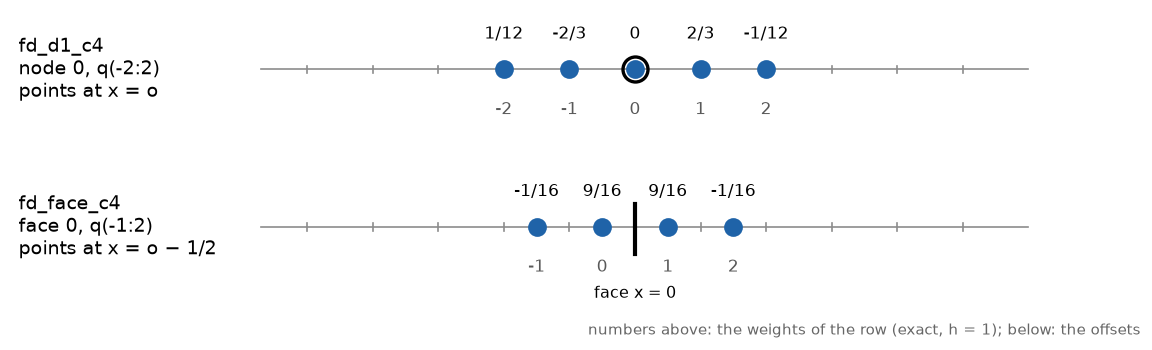
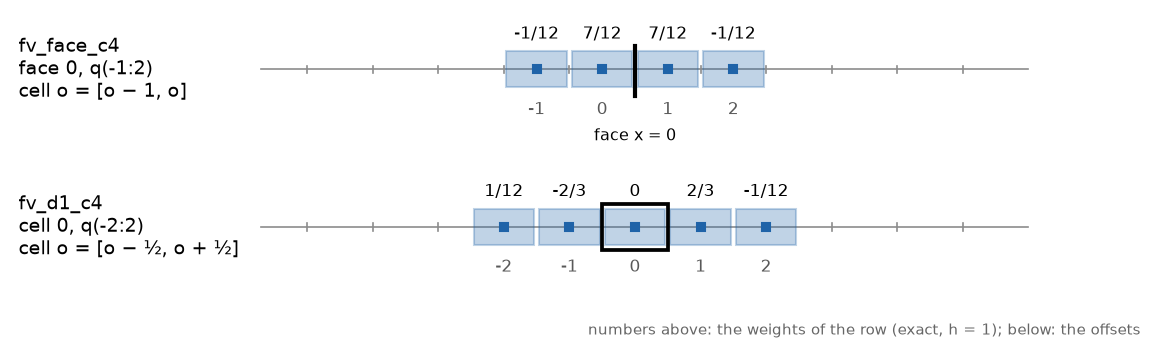
All in units of the grid step; the window is an explicit-shape dummy q(LO:HI), and the caller passes the section q(i+LO:i+HI):
| Geometry | Data at offset o | The result at |
|---|---|---|
fd, node operators | the point x = o | node 0 |
fd, face operators | the point x = o − 1/2 | the face x = 0, between nodes 0 and 1 |
fv, face operators | the cell [o − 1, o] | the face x = 0, between cells 0 and 1 (SETH's face) |
fv, cell operators | the cell [o − 1/2, o + 1/2] | cell 0 (the average over it) |
| Operator | Window |
|---|---|
| centred node or cell, half-stencil S | q(-S:S) |
| centred face | q(1-S:S) |
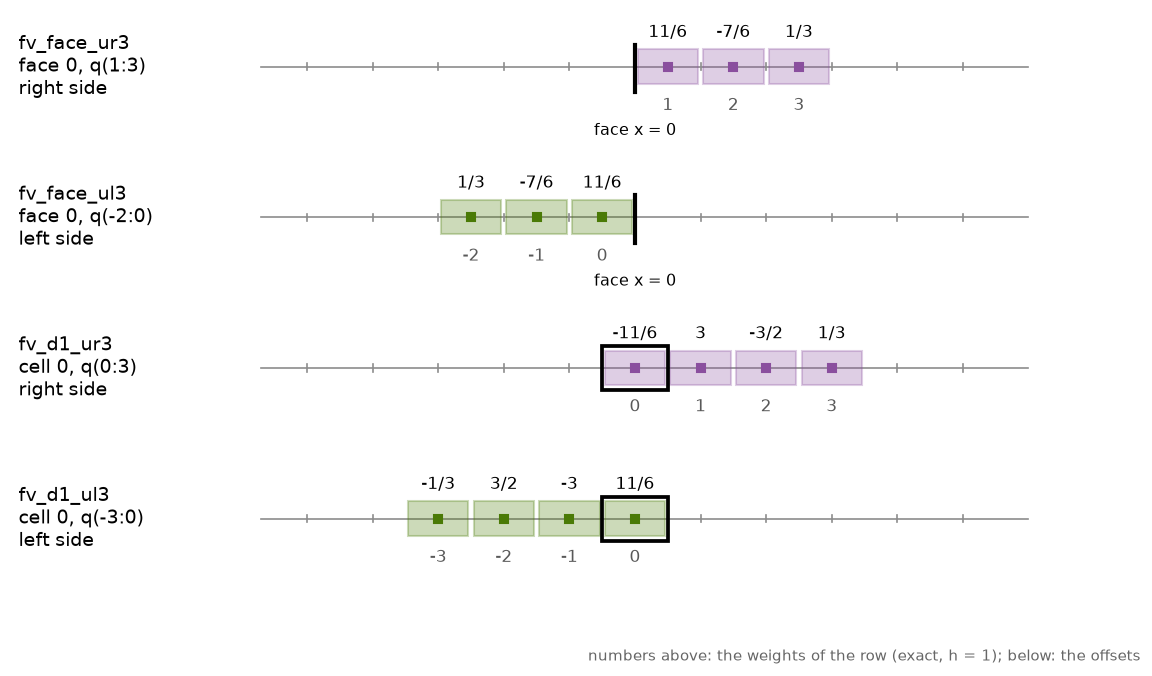
| upwind (one-sided) face, right side (S cells or points) | q(1:S) |
| upwind (one-sided) face, left side | q(1-S:0) |
| biased face, one point more on the left (k + 1 left, k right) | q(-k:k) |
| biased face, one point more on the right | q(1-k:k+1) |
| upwind cell, right side | q(0:S) |
| upwind cell, left side | q(-S:0) |
The window bounds are the caller's responsibility. The explicit-shape dummy names them in the interface, but a section of the wrong length is not an error when its bounds are run-time expressions: the dummy is associated with the section's elements in order, so a section two elements short (u(i-3:i+3) for gideon_fd_d1_c8, whose window is q(-4:4)) is read from u(i-3) as offset −4 and returns the derivative at node i+1, silently, even with gfortran 16.2's -fcheck=all. Only a section of constant wrong length fails, at compile time. What a checked build does catch is a section that leaves the caller's array (-fcheck=bounds, -C, -check all): a halo too thin at the last point of a loop. (ADAM's audit item B, a read past the end of an assumed-shape window, was caught inside the kernel: an assumed-shape dummy carries the section's length, an explicit-shape one does not.) Write the section as u(i+LO:i+HI) with the kernel's own LO and HI, as listed in Operators; for a dispatcher, with the bounds of its window as expressions of the order (API). The ghost cells a loop needs follow from the window: Ghost cells for a window.
The windows drawn, offsets on the axis, the data each kernel reads and the point of its result:
Line operators
A compact operator is not one kernel but three parts (Compact operators): its right side, a kernel like every other (gideon_fd_d1_p6(q, ds, r), the window by offset, the unknown at offset 0: node 0, or the face between data 0 and 1); its band, <NAME>_LEFT in gideon_tables (pairs when symmetric, by offset when not); and a solve along the line, gideon_line_solvers. The unknown at offset
Arithmetic
- Pair form (decision D3): a centred row multiplies pairs,
c_m (q(m) ± q(−m))for a node or cell andc_m (q(m) ± q(1−m))for a face, as ADAM does. Fewer flops, the (anti)symmetry exact, and ADAM's values bitwise. - The step inside (decision D4): the kernels divide by the step as ADAM does, by repeated divisions for
fd(d/ds/ds) and by one product forfv(d/(ds*ds)). - Flux difference: an
fvcell derivative is(g(+1/2) − g(−1/2))/ds^n,gthe face row of the derivative below; the face value is the flux a conservative scheme would difference. - Mirrors: a left-side kernel reads the right-side row mirrored, times (−1)ⁿ; no left row is stored, and the identity is bitwise (audit item A).
Run-time order
gideon_<data>_<op>_<bias>(order, q, [ds,] r) dispatches to the kernel of that order: one select case per call. The window bounds are expressions of order (q(-(order/2):order/2) for gideon_fd_d1_c), so the whole window goes to the kernel. An order without a kernel returns GIDEON_NAN, a quiet NaN: error stop is not device code, and ADAM's silent 0 is what audit item C fixes.
Kinds
The kernels compute in PENF's R_P, chosen when GIDEON (and PENF, compiled by the same mode) is built: -D_R_P_IS_R4P or nothing (R8P). One precision per build. R16P (-DPENF_R16P -D_R_P_IS_R16P, mode tests-gnu-r16) is a host-only verification kind: there the orders of every kernel are observed, which double precision's round-off hides for the widest stencils. An OpenACC build refuses it. The builds and what each verifies: Precision.