Appearance
Forest cookbook
This page is the task-oriented companion of the forest reference. Each recipe is a configuration ADAM runs today:
- a picture of what it builds;
- the manifest and realm keys it needs;
- what the machinery does with them;
- what it refuses;
- how to tell from the log that it did the right thing;
- the test that keeps it working.
The figures are drawn to scale by scripts/make_forest_figures.py (standard library only; run it to regenerate docs/public/forest/*.svg).
What "verified" means here
Every recipe names its tests. Unless stated otherwise the oracle is bitwise: the forest run must reproduce the single-realm run on the same cells to the last bit, on the CPU and the FNL (OpenACC) backends. Where a test holds only to round-off or to a tolerance, the recipe says so and why.
Vocabulary
| Term | Meaning |
|---|---|
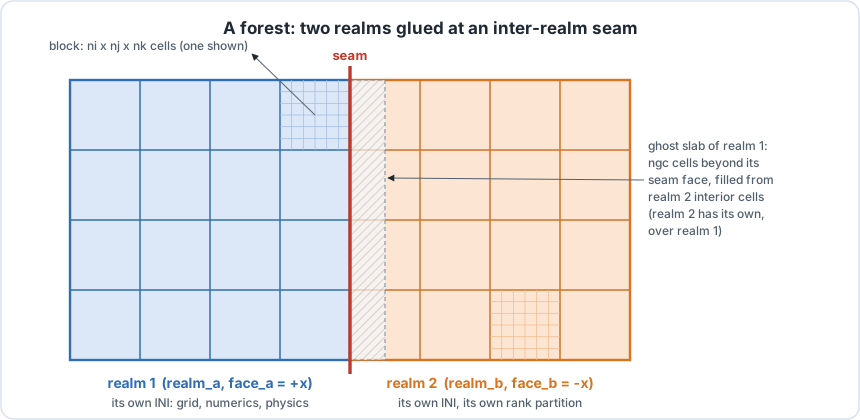
| realm | One simulation domain with its own INI (grid, numerics, physics), its own block tree and its own partition over the MPI ranks. |
| forest | A set of realms advanced together with one global time step. A plain INI is a one-realm forest. |
| manifest | The small INI with a [forest] section that lists the realms and the seams between them. |
| seam | A face where two realms touch (an inter-realm seam, declared in the manifest), or a 2:1 face inside one realm's tree (an intra-realm AMR seam, created by refinement). |
| face pair | One [forest.topology.face_N] entry: realm_a/face_a glued to realm_b/face_b. |
| ghost slab | The ngc layers of ghost cells beyond a realm's seam face, filled from the peer realm. |
| row | One seam ghost to fill: a copy (same cell size), an interpolate (a fine ghost from coarse cells) or a restrict (a coarse ghost from fine cells). |
| flux register | The per-face store of the coarse-side flux and the sum of the fine-side fluxes; after the step the coarse cells get the Berger-Colella correction. |
| cadence | When the seam ghosts are refreshed: before every RK stage (β, stage_coincident) or once per step (α, end_of_step). |
Which recipe?
| You want | Recipe |
|---|---|
| one domain, uniform grid | R1 |
| one domain, finer cells in a region | R2 |
| two domains, same cells, glued | R3 |
| choose how the seam is synchronised, or mix RK schemes | R4 |
| two domains, same cells, different block sizes | R5 |
| two domains, one twice as fine as the other | R6 |
| a seam and refinement inside a realm | R7 |
| any of the above on many ranks | R8 |
| restart a forest | R9 |
| build a split from an existing single-realm input | R10 |
R1. One realm, uniform
A plain INI, no manifest: the forest has one realm and takes the fused fast path (advance_one_step_forest); no seam machinery runs.
ini
[amr]
max_level      = 2
ratio          = 8        ; octree
iu_ref_levels  = 2        ; 4 x 4 x 4 blocks
markers_number = 0- Blocks.
iu_ref_levels = Lgives2^Lblocks per refined axis (x, y, z on an octree; x, y on a quadtree,ratio = 4), each withni x nj x nkcells. - Verified by every single-realm regression case (FLUME
sod-x, PRISMrmf, ...).
R2. One realm with AMR: intra-realm 2:1 faces
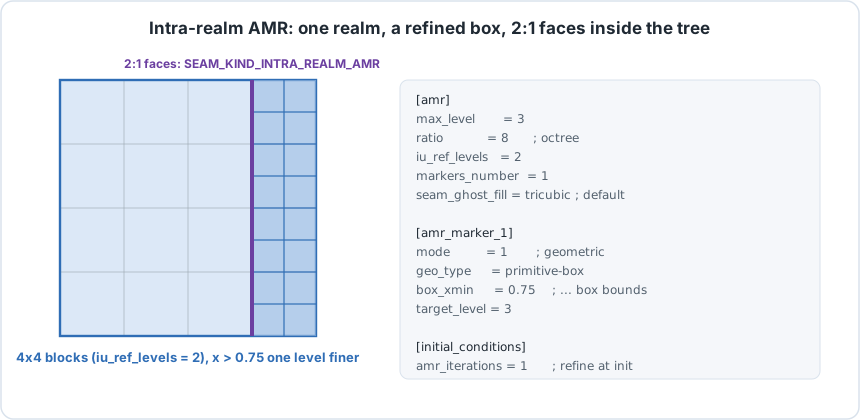
A refinement marker creates blocks one level finer; where a level-l block meets a level-l+1 block the tree has a 2:1 face. No manifest is involved.
What happens at a 2:1 face:
- Ghosts. The fine block's ghosts that overlap the coarse block are interpolated with the
[amr] seam_ghost_fillregime; the coarse block's ghosts that overlap fine cells take the mean of the 2x2x2 fine cells. - Reflux. The face is registered (
SEAM_KIND_INTRA_REALM_AMR); after the step the coarse cells get the Berger-Colella correction (FLUME:[numerics] reflux = .true.).
seam_ghost_fill | Order | Footprint | Use |
|---|---|---|---|
tricubic (default) | q = 4 | 4x4x4 coarse cells | production |
restriction-compatible | q = 2 | 3x3x3 | exact restriction of the interpolant (R∘P = I); diagnostics |
injection | 0 | the anchor cell | legacy, comparisons |
Requirements. The first two are checked at initialisation:
- On an octree (
ratio = 8) with a null z axis,nk >= 4(the tricubic footprint is 4 cells along every refined axis). A quadtree (ratio = 4) never refines z, so anynkworks,nk = 1included (#46; the NVF and GMP backends still refuse quadtree AMR). - Even
ni/nj/nkalong every refined, non-null axis when 2:1 refinement is possible (markers andmax_level > iu_ref_levels): an odd count is refused (#39; it used to give NaN silently). - At least
2 ngccells (6 with WENO5) along the same axes. The coarse ghosts beside a finer block are restricted from2 ngcfine cells; a thinner block makes the outer layers read its own ghosts, which the same exchange is still filling (stale, silently, depending on the exchange order: 0.2 in density between 1 and 2 ranks on the step forest). Refused at initialisation (#66). - At least 4 cells per block on every axis, null axes included, for the coarse-fine interpolation footprint.
Log. forest: registered intra-realm AMR seam faces: +N.
PRISM. A 2:1 face injects an O(h^p) div(B) source that refinement reduces but time does not (#29, accepted). The run-time monitor [IO] seam_divB_tol turns it into a warning or a stop; see the reference.
Verified by FLUME sod-amr (a 2:1 face crossed by a shock), amr-periodic-reflux (V3: conservation to round-off, the negative control without reflux, and the odd-cell refusal), MHD MV-11; PRISM rmf-amr, rmf-amr-fd, rmf-amr-fd-pulse.
R3. Two realms, mirror seam, lined-up blocks
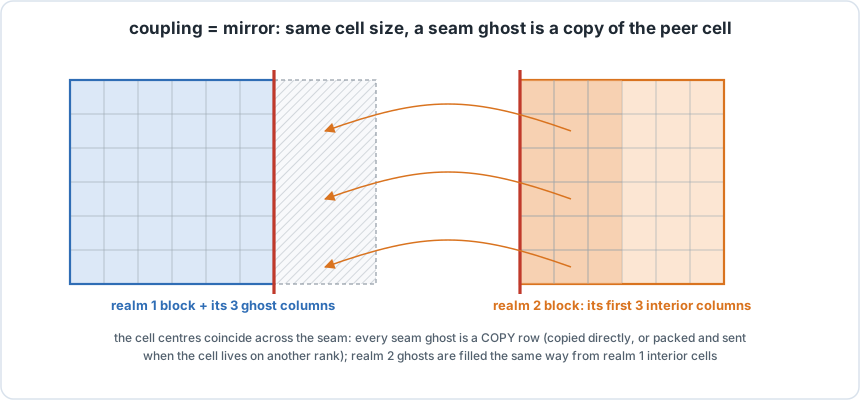
The manifest (any file name; the apps recognise it by its [forest] section):
ini
[forest]
realms_number = 2

[realm.1]
ini = sod-2realm-r1.ini        ; relative to the manifest's directory

[realm.2]
ini = sod-2realm-r2.ini

[forest.topology]
inter_realm_faces_number = 1

[forest.topology.face_1]
realm_a          = 1
face_a           = +x          ; +x | -x | +y | -y | +z | -z
realm_b          = 2
face_b           = -x
coupling         = mirror      ; the default
coupling_cadence = stage_coincident
The realm INIs are complete inputs. For a split of a single-realm domain, each realm keeps the cell size and the block layout and takes its part of the extent:
ini
; realm 1, x in [0, 0.5]                     ; realm 2, x in [0.5, 1]
[grid]                                         [grid]
ni     = 25          ; 50 / 2                  ni     = 25
emin_x = 0.0                                   emin_x = 0.5
emax_x = 0.5                                   emax_x = 1.0
[IO]                                           [IO]
output_basename  = sod-2realm-r1               output_basename  = sod-2realm-r2
restart_basename = sod-2realm-r1-restart       restart_basename = sod-2realm-r2-restart
What happens:
- Ghosts. Every seam ghost is a copy of the peer cell with the same centre. The forest builds the rows at initialisation from the replicated trees; it fills the realm 1 slab from realm 2 and the realm 2 slab from realm 1, edge and corner ghosts included.
- Register. One register face per realm_a seam block. On a mirror seam both sides compute the same flux, so the correction is exactly zero: the forest prints
forest: reflux max|F_coarse-F_fine_sum|only when it is not. - Physical faces. A realm's faces that are not on a seam keep their
[bc_*]boundary conditions.
Requirements.
- The same cell size on both sides, with cell centres that coincide across the seam.
- The two seam faces cover each other.
- One cell size along each realm's seam face (no refinement touching the seam face).
Log. forest: realm R seam rows: L local, R received, S sent (per rank).
Verified by FLUME multirealm/check.sh leg 1 (Sod) and the regression cases sod-2realm (equivalent_to sod-x) and rj2a-2realm (MHD, equivalent_to rj2a-x); PRISM rmf-2realm* and rmf-2realm-fd-pulse (div(B) = div(D) = 0 across the seam).
R4. Seam cadence: α or β
coupling_cadence | Ghosts refreshed | Requires | Gives |
|---|---|---|---|
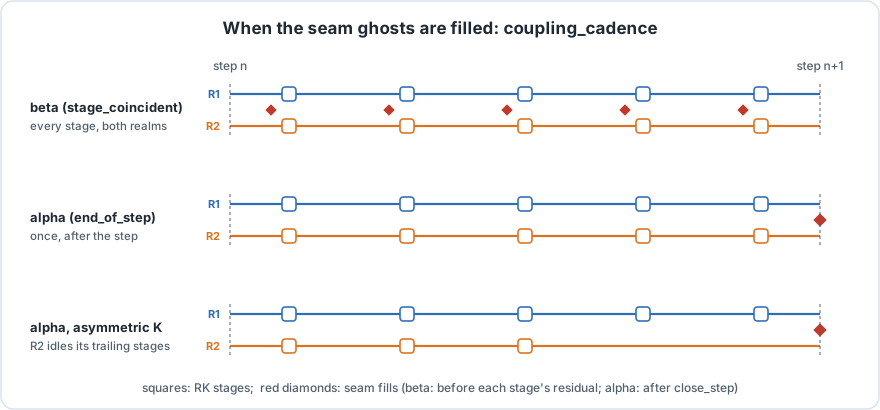
stage_coincident (β) | before every RK stage's residual, from the peer's stage buffer | the same scheme_time, RK scheme, stage count and nv on both sides (checked) | the seam has the time order of the interior; the split reproduces the single realm (bitwise in every FLUME split) |
end_of_step (α, default) | once, after the step, from the peer's committed state | nothing | first-order seam coupling in time; the realms may use different RK schemes (asymmetric K) |
Choose β whenever both realms use the same time integrator. It is the cadence under which a split reproduces the single-realm run, and the only one that keeps a PRISM 1:1 seam divergence-free (#31: under α the substage ghosts are stale and div(B) leaks).
Choose α for different RK schemes per realm (for example SSP-33 next to SSP-54): the realm with fewer stages idles the trailing ones.
Rules.
- β on a pair whose realms differ in scheme, stages or
nvstops at initialisation, naming the field; it is never silently downgraded. - All face pairs joining the same two realms must declare the same cadence.
Verified by PRISM rmf-2realm (α), rmf-2realm-asymK (α, K = 3 and 5), rmf-2realm-stagesync (β, the single-realm golden within the digest tolerances), rmf-2realm-fd-pulse (β div-free, with α as the leaking negative control). Every FLUME forest test uses β.
R5. Mirror seam between blocks that do not line up
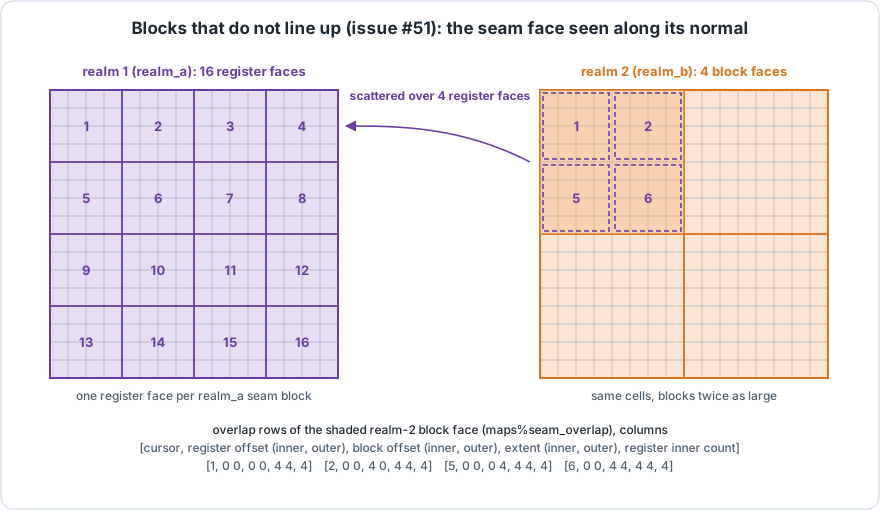
The two realms keep the same cells but use different block sizes along the seam: for example realm 2 with one block level fewer and twice the cells per block. Nothing changes in the manifest (#51).
ini
; realm 1: 4 blocks per axis                ; realm 2: 2 blocks per axis, the same cells
ni = 25   nj = 4   nk = 4                      ni = 50   nj = 8   nk = 8
iu_ref_levels = 2                              iu_ref_levels = 1
What happens:
- Ghosts. They are rows per cell, so block boundaries do not matter.
- Register. At initialisation the forest intersects each register face with the realm_b seam leaves, in cells. Each realm_b block face gets one overlap row per register face it touches (
maps%seam_overlap); at every accumulation its skin is scattered into those faces (flux_register%accumulate_fine_overlaps). A lined-up block has one row covering its whole skin, which is exactly R3.
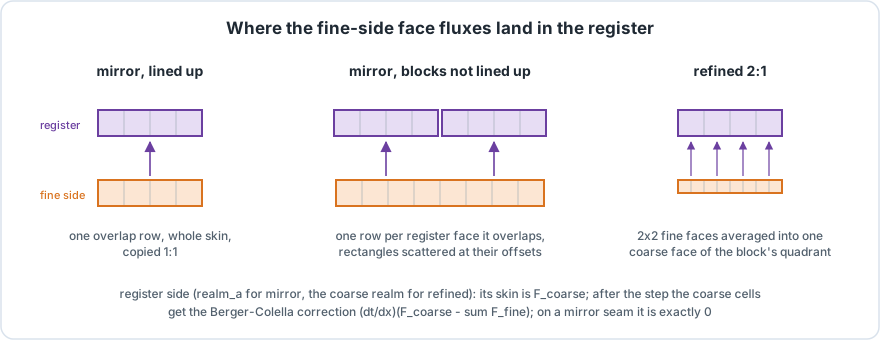
Requirements. The overlaps must be cell-aligned and cover each register face exactly; otherwise the forest stops ("the cells of realm A and realm B do not line up across the seam", or "the seam block ... faces N of its M seam cells").
Verified by:
- FLUME
multirealm/check.shleg 5: Sod split along x and along z with misaligned blocks, bitwise, 2 and 4 ranks. - MV-14 leg 5: the MHD rotor on an octree, misaligned both ways, bitwise on all 9 fields. This is the test with teeth: with the overlap offsets forced to zero the density goes negative at step 2.
- Regression
sod-2realm-blocks(equivalent_to sod-x). - PRISM
rmf-2realm-fv-pulse-blocks: on the FV path the register closes exactly (mismatch 0). The fields agree to 1e-13 only, because PRISM FV changes at round-off with the block layout alone.
R6. Refined seam: a 2:1 jump between realms
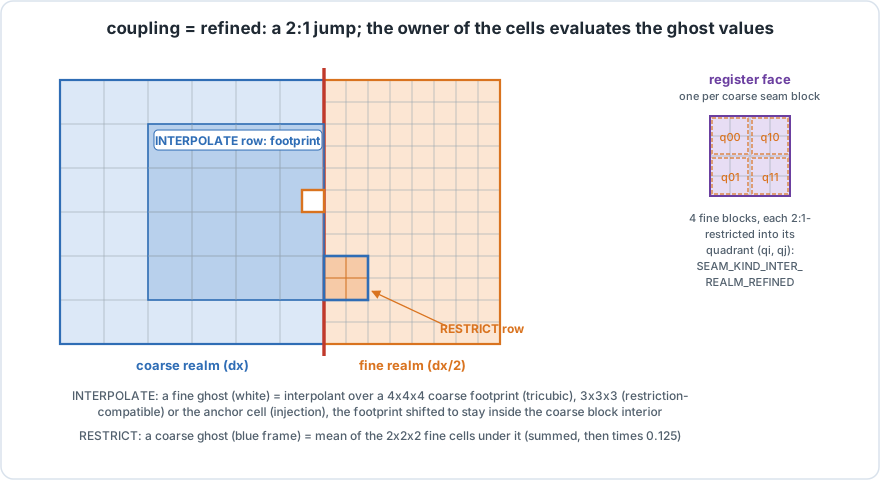
One realm is exactly twice as fine as the other along every axis (#52):
ini
[forest.topology.face_1]
realm_a          = 1
face_a           = +x
realm_b          = 2
face_b           = -x
coupling         = refined           ; the coarse side is found from the cell sizes
coupling_cadence = stage_coincident
ini
; realm 1 (coarse), x in [0, 0.75]          ; realm 2 (fine), x in [0.75, 1]
ni = 36   nj = 4   nk = 4                      ni = 12   nj = 4   nk = 4
iu_ref_levels = 2      ; dx = 1/192            iu_ref_levels = 3      ; dx = 1/384
seam_ghost_fill = tricubic ; [amr]             seam_ghost_fill = tricubic ; [amr]
What happens:
- Rows. The seam reuses the intra-realm 2:1 formulas. A fine-side ghost is an interpolate row: the owner of the coarse cells evaluates the
seam_ghost_fillinterpolant around the coarse cell containing the ghost. A coarse-side ghost is a restrict row: the mean of the 2x2x2 fine cells under it. Rows whose cells live on the same rank travel as messages to self. - Register. One register face per coarse seam block. Its four fine blocks are each restricted 2:1 into their quadrant (
SEAM_KIND_INTER_REALM_REFINED). - Time. No subcycling: both realms take the global time step.
Requirements. Each is checked, with a named error:
- A cell-size ratio of exactly 2 along every axis.
- The same block cell counts along the seam (the tangential
n). - The same
[amr] seam_ghost_fillin both realms. - Even
ni,nj,nkin the fine realm. - Nested blocks: every fine seam block covers one quadrant of one coarse seam block face.
- Declaring such a pair
mirroris refused ("coupling = mirror joins cells of the same size").
Log. forest: face_pair 1 is a 2:1 seam, realm 1 coarse, realm 2 fine (issue #52).
PRISM. The 2:1 seam carries the same O(h^p) div(B) source as an intra-realm 2:1 face (#29), and the [IO] seam_divB_tol monitor covers it.
Verified by:
- FLUME
multirealm/check.shleg 4:sod-amrsplit at its 2:1 face, along x and along z, bitwise, CPU np 2-4 and FNL. - MV-14 leg 4: RJ2a on the same cells, all 9 fields bitwise.
- Regression
sod-amr-refined(equivalent_to sod-amr). - PRISM
rmf-2realm-fd-pulse-refined: bitwise on all 27 fields, the #29 source unchanged, the monitor fires.
R7. Both families: a mirror seam and AMR inside a realm
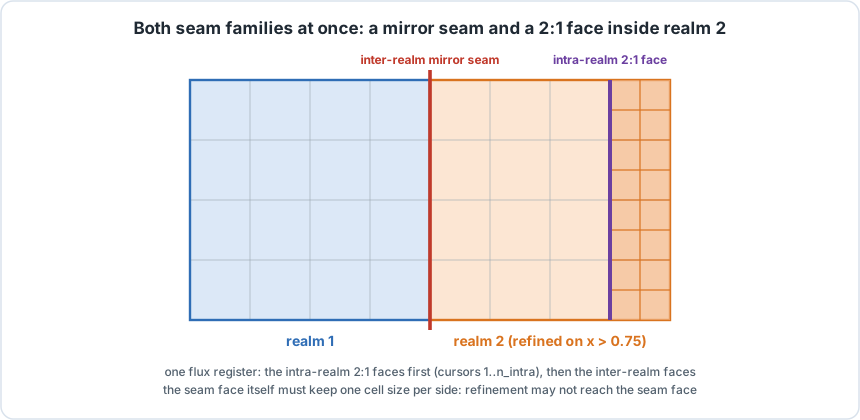
A realm of a forest may carry its own refinement, as in R2, away from its seam face. The register then holds both kinds of face, the intra-realm 2:1 faces first, and one reduction completes them.
Requirement. Refinement must not reach the seam face: each realm's seam face keeps one cell size ("realm R has seam cells of different sizes (refined blocks along the seam)"). To put a resolution jump on the seam, use R6.
Verified by FLUME multirealm/check.sh leg 2 and the regression case sod-amr-2realm (equivalent_to sod-amr). Before the register composed the two kinds, the 2:1 face got no reflux.
R8. Many ranks
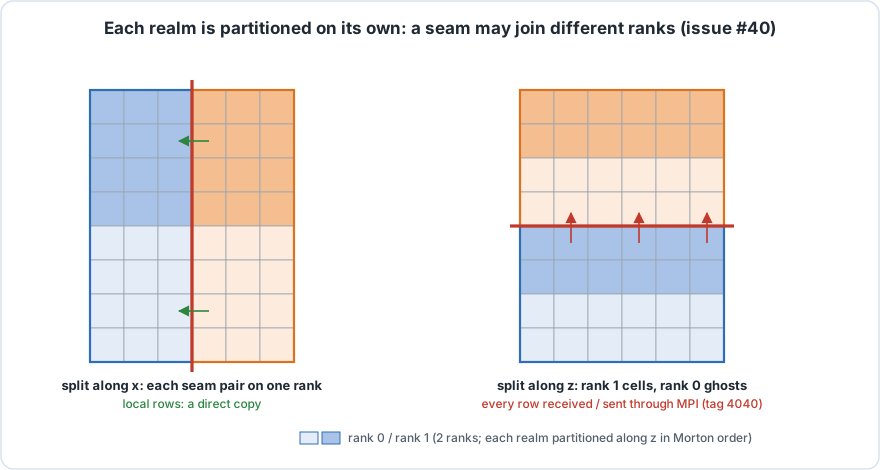
Nothing to configure. Each realm is partitioned over all ranks on its own (Morton order), so the two sides of a seam may live on different ranks (#40):
- Rows. Every rank enumerates every seam row from the replicated trees, in one canonical order. It keeps local rows (a direct copy, device to device on FNL), receive rows and send rows. The sends and receives match one to one with no index exchange (point-to-point MPI, tag 4040).
- Register. It is replicated and completed by a reduction per face.
Check. The seam rows log line: on an x split the rows are local, while on a z split at 2 ranks they are all received and sent.
Cost. Set ADAM_SEAM_TIMING=1 (mpirun -x ADAM_SEAM_TIMING) to print, at the end, the time per phase of the seam fill and of the reflux (#53). On FNL the cross-rank rows go through host buffers; the fills of all pairs are posted together and completed by one wait. On medooza (A30, 2-4 ranks) the transfer is at most about 3.5% of the step; a large seam imbalance means one rank reaches the fill late (load imbalance), not a slow exchange.
Verified by FLUME multirealm/check.sh legs 1-5 at np 2, 3 and 4 (leg 3: the z split equals sod-z bitwise on 1 and N ranks).
A rank may own no block of a realm. Every collective in the step must then still be entered by that rank, so a code change that skips work on empty ranks must keep the collectives. The PRISM FNL residuals once hung this way; rmf-2realm-fd-pulse-refined at np 2 covers it.
R9. Restart
Each realm restarts from its own files, with the usual keys in its own INI:
ini
[IO]
restart_save     = 100                      ; write every 100 steps
restart          = .false.                  ; .true. to resume
restart_basename = sod-2realm-r1-restart    ; DIFFERENT in every realm
Give every realm its own restart_basename (and output_basename). Two realms writing to the same name overwrite each other's files.
Verified by MV-14 legs 2 and 3: a 2-realm run stopped at half its steps and restarted equals the straight run bitwise, with byte-identical histories; leg 3 does the same on an AMR box with a non-zero psi.
R10. Splitting an existing input
src/tests/flume/verification/mhd/multirealm/make_split.py splits a single-realm input in two at the centre of x, halving ni and writing the manifest:
bash
make_split.py single.ini out-dir name                       # R3: lined-up blocks
make_split.py single.ini out-dir name --coarse-blocks 2     # R5: realm 2 on blocks twice as large
make_split.py single.ini out-dir name --set time.it_max=50  # override a key in both realms
For a refined split (R6), start from a single-realm run with a box marker. Give the coarse realm the coarse part, unrefined; give the fine realm the refined part, built uniform one level finer (iu_ref_levels + 1, cell counts chosen so that dx halves). Drop the markers in both. verification/multirealm/sod-amr-refined*.ini and src/tests/prism/regression/rmf-2realm-fd-pulse-refined/ are worked examples.
Diagnostics
| Log line | Meaning |
|---|---|
forest: realm R seam rows: L local, R received, S sent | rows this rank fills locally, receives and sends for realm R |
forest: face_pair N is a 2:1 seam, realm C coarse, realm F fine | a refined pair was accepted |
forest: registered intra-realm AMR seam faces: +N | 2:1 faces inside the realms (R2, R7) |
forest: reflux max|F_coarse-F_fine_sum| = ... | printed only when non-zero: expected on 2:1 faces, never on a mirror seam |
forest timing (max over ranks, s): ..., forest seam timing realm R ... | with ADAM_SEAM_TIMING=1 |
WARNING: seam div(B) ... exceeds [IO].seam_divB_tol | PRISM, with the monitor armed (R2, R6) |
Refusals and fixes
| Message (abridged) | Cause | Fix |
|---|---|---|
only coupling = mirror or refined is implemented | periodic / interpolate | reserved names; before #52 they silently ran as mirror |
coupling = mirror joins cells of the same size, the seam cells differ | different cell sizes on a mirror pair | equal cells, or coupling = refined for a 2:1 jump |
coupling = refined needs ... (a ratio of exactly 2, the same block cell counts along the seam, the same seam_ghost_fill, even counts, nested blocks) | an R6 requirement | see R6 |
realm R has seam cells of different sizes | refinement reaches the seam face | keep refinement away from the seam (R7), or put the jump on the seam (R6) |
the cells of realm A and realm B do not line up / faces N of its M seam cells | misaligned cells, or faces that do not cover each other | align the extents to the cell size; make the seam faces coincide |
the seam ghost (i,j,k) of block b of realm R does not match the cells of realm P ...; ghost centre ..., peer cell ... | a peer cell of the wrong size or position | as above |
stage_coincident requires equal scheme_time / rk_scheme / physics nv / K | β on unlike realms | end_of_step, or align the integrators |
conflicting coupling_cadence between realm A and realm B | two pairs between the same realms with different cadences | one cadence per realm pair |
[amr] ratio = 4 (quadtree) with AMR markers ... on the NVF and GMP backends | #46: their ghost kernels are octree-only | ratio = 8, or the CPU/FNL backend |
[grid].(ni)=+7 is odd: 2:1 refinement ... | #39 | even counts along refined axes |
[grid].(nj)=+4 is less than 2*ngc = +6 ... | #66: thin blocks read stale ghosts at 2:1 seams | at least 2 ngc cells along refined axes |
(positivity_limiter)=cell is not supported on multi-realm runs | the FLUME limiter | no limiter in a forest |
Current limits
- Topologies. The schema takes any number of realms and face pairs, but the verified forests have two realms and one face pair.
- Time stepping. There is no subcycling: one global time step, set by the most restrictive realm.
- FLUME limiter. The positivity limiter is refused in a forest.
- FNL cost. On FNL the cross-rank seam rows go through the host on every fill (#53).
- Divergence at 2:1 seams. A 2:1 seam, inter- or intra-realm, is not divergence-free for collocated B in PRISM (#29, accepted, monitored).
- Reflux by app. FLUME accumulates the seam fluxes of every stage weighted by its SSP coefficient. PRISM accumulates its final stage (α.r1), and only on the FV path: the FD path does not use the register.
Verification map
| Scenario | FLUME | PRISM | Oracle |
|---|---|---|---|
| R2 intra-realm 2:1 | sod-amr, amr-periodic-reflux (V3), MV-11 | rmf-amr* | goldens; conservation to round-off |
| R3 mirror, lined up | leg 1, sod-2realm, rj2a-2realm | rmf-2realm, rmf-2realm-fd-pulse | bitwise; div-free |
| R4 α / β / asymmetric K | (all β) | rmf-2realm, -asymK, -stagesync, -fd-pulse | goldens; β matches the single realm |
| R5 misaligned blocks | leg 5, MV-14 leg 5, sod-2realm-blocks | rmf-2realm-fv-pulse-blocks | bitwise; register exact |
| R6 refined 2:1 | leg 4, MV-14 leg 4, sod-amr-refined | rmf-2realm-fd-pulse-refined | bitwise |
| R7 both families | leg 2, sod-amr-2realm | — | bitwise |
| R8 many ranks | legs 1-5 at np 2-4, leg 3 (z split) | np 2 in every case | bitwise |
| R9 restart | MV-14 legs 2-3 | — | bitwise, histories identical |
"leg N" is src/tests/flume/verification/multirealm/check.sh (--legs legN; leg 4 needs leg 2, leg 5 needs legs 1 and 3); "MV-14 leg N" is src/tests/flume/verification/mhd/multirealm/check.sh (--legs mv14-N; leg 2 needs leg 1). FLUME case names are regression cases under src/tests/flume/regression/, PRISM ones under src/tests/prism/regression/.