8. Many vectors at once
A mesh has thousands of faces, a particle cloud millions of points. probe estimates the volume of its tetrahedron by counting the points of a 40 x 40 x 40 grid that fall inside it, testing all 64000 points with one call per face.
program probe
!< Tutorial, chapter 8: many points at once, the volume of the tetrahedron counted on a grid.
use penf, only : R8P
use vecfor, only : ex, ey, ez, face_normal3, normL2, vector
implicit none
integer, parameter        :: n = 40       ! grid points per direction
type(vector)              :: o            ! the origin
type(vector)              :: p(4)         ! the vertices
integer                   :: face(3,4)    ! the vertices of each face, counter-clockwise seen from outside
type(vector)              :: normal(4)    ! the unit normals of the faces
type(vector), allocatable :: g(:)         ! the grid points, at the centres of n**3 cells of the unit cube
logical,      allocatable :: inside(:)    ! is each grid point inside?
real(R8P),    allocatable :: dist(:)      ! signed distances to a face
integer                   :: i, j, k, f   ! counters

p(1) = o ; p(2) = ex ; p(3) = ey ; p(4) = ez
face = reshape([1,3,2, 1,2,4, 1,4,3, 2,3,4], [3,4])
normal = face_normal3(pt1=p(face(1,:)), pt2=p(face(2,:)), pt3=p(face(3,:)), norm='y')   ! four faces, one call
print '(A,4F8.4)', 'x of the normals ', normal%x
print '(A,4F8.4)', 'their lengths    ', normL2(normal)
allocate(g(n**3))
do k = 1, n
   do j = 1, n
      do i = 1, n
         g(i + n * (j - 1) + n**2 * (k - 1)) = ((i - 0.5_R8P) * ex + (j - 0.5_R8P) * ey + (k - 0.5_R8P) * ez) / n
      enddo
   enddo
enddo
allocate(inside(size(g)), source=.true.)
do f = 1, 4
   dist = g%distance_to_plane(pt1=p(face(1,f)), pt2=p(face(2,f)), pt3=p(face(3,f)))   ! every point, one call
   inside = inside .and. dist <= 0._R8P
enddo
print '(A,I0,A,I0)', 'points inside    ', count(inside), ' of ', size(g)
print '(A,F8.4,A,F8.4)', 'volume estimate  ', count(inside) / real(size(g), R8P), ', exact', 1._R8P / 6
print '(A,I0)', 'points within 0.5 of the origin  ', count(g < 0.5_R8P)
i = maxloc(normL2(g), dim=1)
print '(A,3F8.4)', 'the farthest point from the origin', g(i)%x, g(i)%y, g(i)%z
print '(A,L1)', 'g(1) shorter than g(2): ', g(1) < g(2)
endprogram probe$ probe
x of the normals 0.0000 0.0000 -1.0000 0.5774
their lengths 1.0000 1.0000 1.0000 1.0000
points inside 10660 of 64000
volume estimate 0.1666, exact 0.1667
points within 0.5 of the origin 4194
the farthest point from the origin 0.9875 0.9875 0.9875
g(1) shorter than g(2): T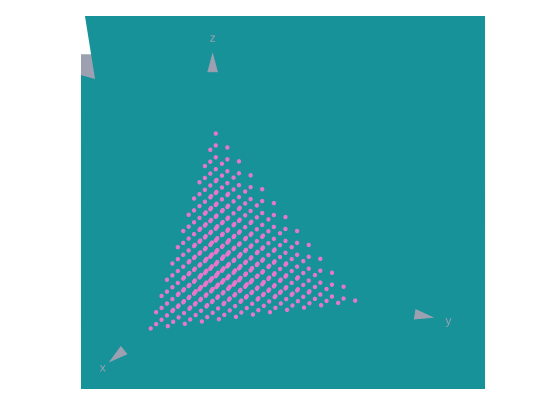
Elemental functions
The operators of VecFor (but .matrix.) and its functions of vectors are elemental: called with arrays, they work element by element and return an array. face_normal3(pt1=p(face(1,:)), ...) takes three arrays of four points (vector subscripts pick the vertices of each face) and returns the four unit normals; normL2(normal) returns their four lengths. g%distance_to_plane(...) calls the method on an array of vectors and returns 64000 distances.
normal%x is the array of the x components of the four normals: a component of an array of vectors is an array of numbers, usable anywhere an array is, as in sum(p%x).
call p%normalize is elemental too, and normalizes a whole array in place. rotate and mirror, the matrices of rotation_matrix and mirror_matrix, .matrix. and the input/output procedures are not: call them in a loop.
The volume, counted
A point is inside when its signed distances to the four faces are all non-positive (chapter 5). 10660 points of 64000 pass: 0.1666, against the exact 1/6. The cells cut by the slanted face make the difference, and it shrinks as the grid gets finer.
Comparisons are by length
g < 0.5_R8P compares the length of every point with 0.5, so count(g < 0.5_R8P) counts the points within 0.5 of the origin: 4194, the volume of an eighth of a ball of radius 0.5 (0.0654) times 64000. Between two vectors, <, <=, > and >= compare lengths too; == and /= compare length and direction (see Comparing two vectors). maxloc(normL2(g), dim=1) finds the farthest point, the corner cell at (0.9875, 0.9875, 0.9875).
What you learned
Elemental operators and functions on arrays of vectors, a component of an array of vectors, comparisons by length. Reference: The vector type, Operators.
Next: 9. Precision.