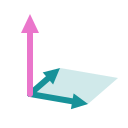
Rotations and mirrors
Rotations about an axis through the origin and reflections across a plane through the origin, applied in place by a method or computed as a 3 x 3 matrix. The angles are in radians; the axis and the normal need not be unit vectors, and the matrices are real arrays of shape (3, 3) of the kind of the vector.
Rotations
| Call | Effect |
|---|---|
call v%rotate(axis=a, angle=t) | v turned by t about a |
call v%rotate(matrix=r) | v becomes r .matrix. v |
r = rotation_matrix(axis=a, angle=t) | the matrix of the rotation |
The rotation is counter-clockwise seen from the tip of a (the right-hand rule). With
matmul(r2, r1), r1 applied first; the inverse is transpose(r), or the same axis with -t.
Mirrors
| Call | Effect |
|---|---|
call v%mirror(normal=n) | v reflected across the plane through the origin orthogonal to n |
call v%mirror(matrix=m) | v becomes m .matrix. v |
m = mirror_matrix(normal=n) | the matrix of the reflection |
The matrix is Householder's, with
mirror(normal=n) gives the same vector as v - 2 * (v .paral. n).
Fixed after v1.5.1
Up to v1.5.1 the off-diagonal terms of mirror_matrix lacked the factor mirror was right only for a normal along an axis.
Away from the origin
Both transformations act about the origin. For an axis through a point o, or a plane through o, move o to the origin, transform, move back:
w = v - o
call w%rotate(axis=a, angle=t)     ! or: call w%mirror(normal=n)
w = w + o
Not elemental
rotate and mirror change their vector in place and are pure, not elemental; rotation_matrix, mirror_matrix and .matrix. return or take a matrix. Loop over an array of vectors, computing the matrix once:
r = rotation_matrix(axis=a, angle=t)
do i = 1, size(p)
   p(i) = r .matrix. p(i)
enddo
None of these is available in device code: see Device-callable API.