


A1 Order conditions
| ID | Group | Type | Backends | Figure | Program |
|---|---|---|---|---|---|
| A1 | Accuracy | P | CPU (gfortran, nvfortran, ifx; debug and optimised; R8P and R4P) | yes | selah_test_schemes |
Case and scope
A Runge–Kutta scheme has order
- typed literals (euler, ssp-22, ssp-33, rk4);
- Shu–Osher coefficients converted at run time (ssp-54, ssp-104);
- 2N coefficients converted at run time (lsrk-33, lsrk-54).
A digit lost in any of them shows up here first.
What the case catches:
- a wrong coefficient: a residual far above round-off, up to the declared order;
- a scheme better than declared: when
, some condition of order must fail. Otherwise the declared order is not the scheme's order; - an inconsistent tableau:
, and A strictly lower triangular (explicit).
Setup
| Item | Value |
|---|---|
| Conditions | the 8 trees of 1–4 nodes: |
| Arithmetic | the stored coefficients converted to quadruple precision (selected_real_kind(33); R8P with nvfortran, which has none) |
| Bound | 64 ε(R_P) on every condition up to |
| Code | order_residuals in selah_test_tools.F90 |
Program
bash
fobis build --mode tests-gnu && ./exe/selah_test_schemes
SELAH_VV_DIR=exe/vv-data ./exe/selah_test_schemes      # report mode: order-conditions.dat
Results
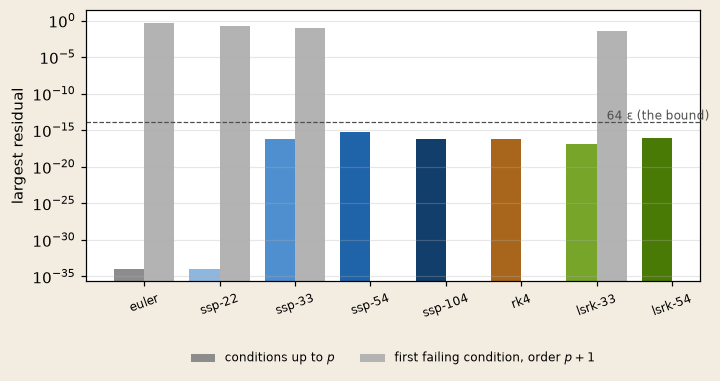
The largest residual of the conditions up to the declared order (coloured), and of the first conditions of the next order (grey).
| Scheme | Order | Largest residual, trees up to | Largest residual, trees of |
|---|---|---|---|
euler | 1 | 0 | 0.5 |
ssp-22 | 2 | 0 | 0.1667 |
ssp-33 | 3 | 5.55e-17 | 0.08333 |
ssp-54 | 4 | 5.13e-16 | — |
ssp-104 | 4 | 6.04e-17 | — |
rk4 | 4 | 5.55e-17 | — |
lsrk-33 | 3 | 1.16e-17 | 0.04167 |
lsrk-54 | 4 | 8.68e-17 | — |
Residuals in quadruple precision (R8P with nvfortran). Exact zero shows as 0.
Findings
- Every scheme satisfies its conditions to round-off of the stored coefficients. The coefficients converted at run time (ssp-54, ssp-104, the 2N schemes) are within a few ε, the literal ones exact.
- No scheme of order below 4 is accidentally of higher order.
- The same program also checks the SSP coefficients (P2), the equivalence of the coefficient forms, the consistency of the Shu–Osher forms (each row of α sums to 1) and the published values.