


Concepts
What a solver needs to know to use SELAH correctly: the shape of a field, what a kernel touches, how the work of a step is split between the stepper and the caller, and what each storage form keeps.
The field
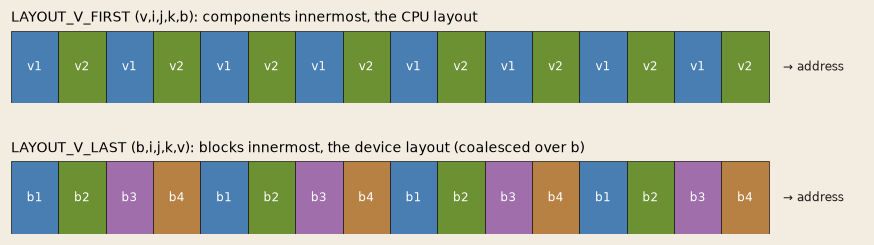
SELAH works on the fields of block-structured solvers. A field is a rank-5 array: components, the three cell indices with their ghost cells, and the blocks of a pool. It has one of two layouts:
| Layout | Index order | Contiguous in memory | Used by |
|---|---|---|---|
LAYOUT_V_FIRST | (v, i, j, k, b) | the components of a cell | CPU fields (ADAM's CPU backend) |
LAYOUT_V_LAST | (b, i, j, k, v) | the same cell of every block | device fields (ADAM's FNL backend): consecutive GPU threads read consecutive blocks |
The cell indices run from 1-ngc to n+ngc, ghost cells included. Components and blocks start at 1. The pool may hold more blocks than are active.
The box
A kernel updates a box: the interior cells of the active blocks, every component or a range of them. It writes nothing else.
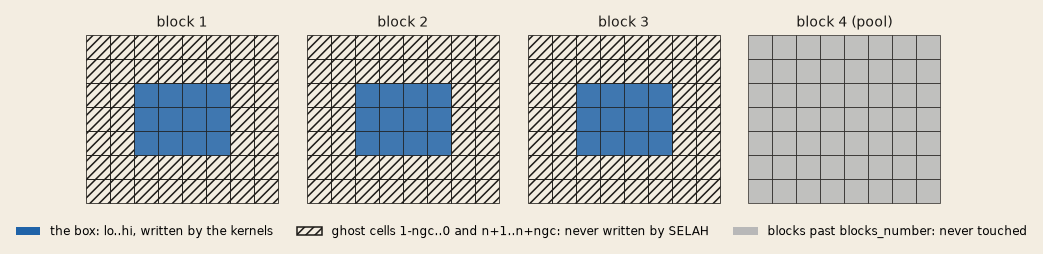
box_interior(layout, nv, ni, nj, nk, ngc, blocks_number)builds the box of the firstblocks_numberblocks.bx%lbholds the array's lower bounds, which the kernels need to address it (ghosts included).bx%lo:bx%hiis the loop range.box_components(bx, v1, v2)narrows a box to componentsv1..v2: a partition of a splitting, or the passive scalars of a solver.- A box is passed at every call and never stored, because the active blocks change at every regrid.
Arrays reach the kernels with their own lower bounds: every dummy is declared q(bx%lb(1):, …, bx%lb(5):). An assumed-shape dummy without bounds would renumber a field with ghost cells from 1 and shift the interior.
Masks
Every box kernel and every stepper call takes an optional mask: an array with the field's bounds and one or more components. A cell is active where the mask is negative, as with a level-set distance that is negative in the fluid. mask_comp picks the component; the default is the last (ADAM's "all solids" summary). Inactive cells are left untouched, except the step residual dq, which is 0 there.
The stage contract
The stepper and the caller share the work of a step. The stepper builds stage states and updates. The caller fills ghost cells and evaluates residuals. The stage contract is the agreement that makes this safe:
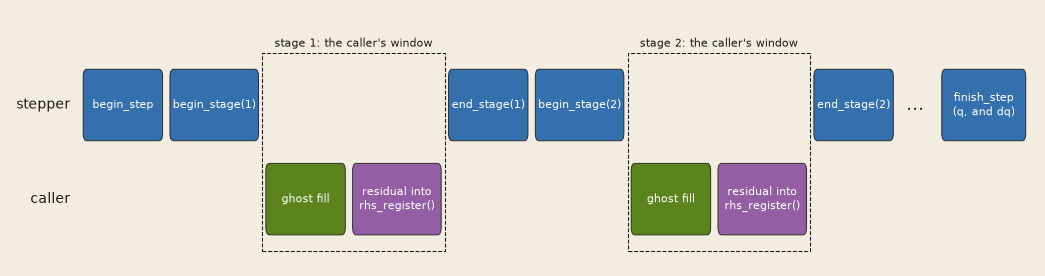
- Between
begin_stage(k)andend_stage(k), the stage state holds the state of stagein the cells of the box: qitself whenstage_state_is_q(k), elsestage_state(). - The stepper never writes a ghost cell, of any register or of
q. - The caller may write the ghost cells of the stage state during that window: ghost exchange, AMR seam fill, physical boundaries.
rhs_register()is written by the caller only, in the cells of the box, and is never the stage state. Outside the window,rhs_register()andstage_state()are null: fetch them again at every stage.- After
finish_stepthe registers are scratch.
stage_weight(k) is the effective Butcher weight
Storage forms
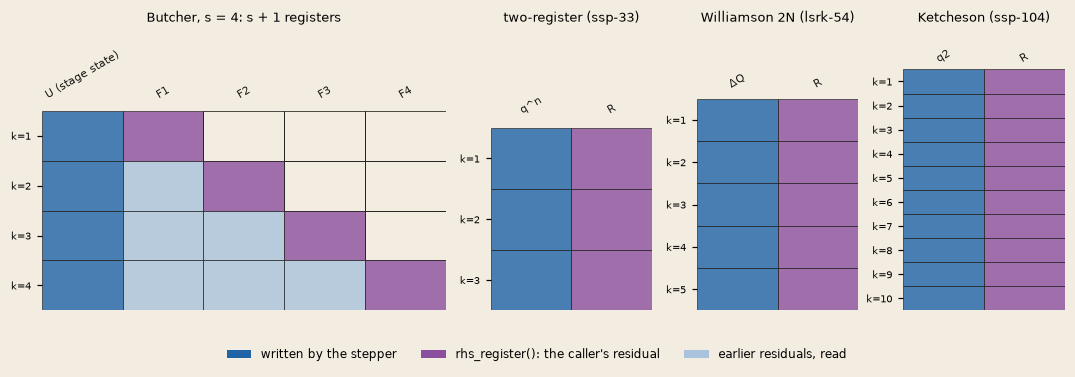
A scheme can run in several storage forms, which keep different registers and do the work at different calls:
| Form | Registers | Schemes | The stage state | Where the work happens |
|---|---|---|---|---|
FORM_BUTCHER | s + 1 | every Runge–Kutta scheme | its own register (or q, with stages_on_q, for the zero rows of A) | begin_stage: the state from q and the earlier residuals; finish_step: the update (and dq) |
FORM_SHU_OSHER_2R | 2 | euler, ssp-22, ssp-33 | q | begin_step: a copy of end_stage: |
FORM_WILLIAMSON_2N | 2 | lsrk-33, lsrk-54 | q | end_stage: |
FORM_KETCHESON_2R | 2 | ssp-104 | q | begin_step: a copy; end_stage: Ketcheson's recipe |
FORM_SPLITTING | 1 | every splitting | q | end_stage: the flow's partition, |
The low-storage forms give the same solution as the Butcher form, to round-off (C2). Only the Butcher form can return the step residual dq, because only it holds every stage residual until the update.
Ownership
| What | Owner |
|---|---|
the solution q, its ghost cells, the time loop, the residual, the mask | the caller |
| the registers | the stepper (allocated through FUNDAL, freed by destroy), or the caller (registers=: the stepper never frees them) |
| the coefficients | the stepper (device copies of A and b in a device build) |
The stepper has no finalizer: call destroy. Its components are public for the tests' sake, but they are not part of the API, and code should not read them.